
.jpg)
Clinical Research
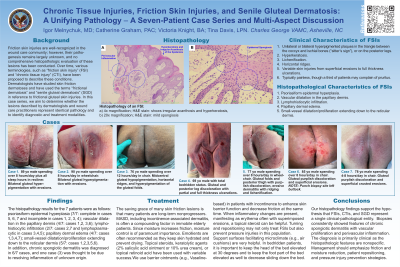
In 2009, NPIAP guidelines separated friction from shear, and friction was no longer considered an independent risk factor for pressure injury formation. This has led to a decrease in research on friction injuries despite increasing recognition in wound care and dermatology. Additionally, there have been no histopathologic findings across diverse skin tones. This study aims to unify the terminology and pathology of friction skin injury (FSI), chronic tissue injury (CTI), and senile gluteal dermatosis (SGD), which may represent the same underlying condition. Understanding this pathology is essential for accurate diagnosis, appropriate treatment, and skin injury prevention.
Methods:
We conducted a case series of seven elderly, mostly immobile male patients (BMI range 29–39) presenting with gluteal and posterior leg skin friction injuries at the Charles George VA Medical Center between 2024 and 2025. All underwent 3 mm punch biopsies and histopathologic review by two pathologists. We performed a systematic literature review (n=500 articles, 22 selected) from PubMed and Google Scholar using keywords “friction skin injury,” “senile gluteal dermatosis,” and “chronic tissue injury.” Treatment included offloading, moisture control, topical emollients and autologous skin micrografting.
Results:
Our findings support that FSIs, CTIs, and SGD represent a single clinical-pathologic entity. Biopsies consistently showed features of chronic spongiotic dermatitis with vascular proliferation and perivascular inflammation.
Discussion:
The diagnosis of FSI is primarily clinical, as histopathologic features are nonspecific. Management should emphasize friction and moisture reduction, patient repositioning, and pressure injury prevention strategies. This series provides the first matched histopathologic case series from a U.S. institution across diverse skin tones. Larger studies are warranted to refine diagnostic criteria and assess preventive interventions such as moisture-control and offloading in at-risk populations.