
.jpg)
Clinical Research
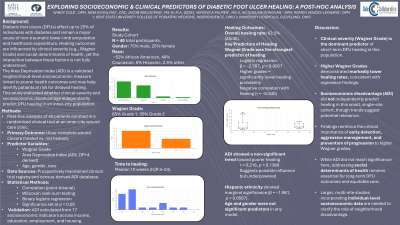
Diabetic foot ulcers (DFUs) are a major complication of diabetes, with healing outcomes influenced by clinical and social determinants. This post-hoc analysis investigates the relationship between Area Deprivation Index (ADI), clinical predictors and DFU healing among recent randomized clinical trial participants of in inner-city clinic.
Methods:
Data from 50 DFU patients were analyzed using their 9-digit ZIP codes to obtain ADI scores (scale 0–100). The primary outcome was ulcer healing (binary: healed vs. not healed). Explanatory variables included ADI, gender, age, race, and Wagner Grade. Statistical methods included point biserial correlation, Wilcoxon rank sum tests, binary logistic regression, and generalized additive models (GAMs).
Results:
While ADI showed a weak, non-significant trend toward improved healing with higher deprivation scores indicating that patients from more socioeconomically disadvantaged areas may experience slightly worse healing outcomes. However, Wagner Grade emerged as a highly significant predictor of healing (β = -2.767, p = 0.0057), with higher grades strongly associated with reduced healing likelihood. These findings highlight the need for further investigation into socioeconomic factors and their interaction with clinical severity in DFU outcomes.