
.jpg)
Clinical Research
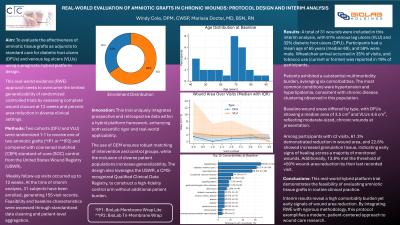
Randomized controlled trials (RCTs) remain the gold standard for evaluating clinical interventions, yet their rigid protocols and narrowly defined populations often limit generalizability. Real-world evidence (RWE) studies address this gap by assessing treatment effectiveness in diverse, routine care settings. This study employs a pragmatic hybrid platform design to evaluate amniotic tissue grafts as adjuncts to standard care for diabetic foot ulcers (DFUs) and venous leg ulcers (VLUs). Primary outcomes include complete wound closure at 12 weeks and percent area reduction, providing insights into the performance of these grafts under real-world conditions.
Methods:
Two cohorts (DFU and VLU) were randomized 1:1 to receive one of two amniotic grafts and compared with coarsened matched standard-of-care (SOC) control matched from the United States Wound Registry. Weekly follow-up visits occured up to 12 weeks. At the time of interim analysis, 31 subjects had been enrolled, generating 155 visit records. Feasibility and baseline characteristics were assessed through standardized data cleaning and patient-level aggregation.
Results:
Interim analysis reflects 61% VLU and 32% DFU; mean age was 65 years (median 69), with 58% male. Wheelchair arrival occurred in 35% of visits; tobacco use was 19% (current or former). Patients averaged six comorbidities, most commonly hypertension and hyperlipidemia. Among patients with ≥2 visits, 61.3% showed decreased wound area and 22.6% showed increased granulation.
Discussion:
This real-world hybrid platform trial demonstrates the feasibility of evaluating amniotic tissue grafts in routine clinical practice. Interim results reveal a high comorbidity burden yet show early signals of wound area reduction. By integrating real-world evidence with rigorous methodology, this protocol exemplifies a modern, patient-centered approach to wound care research and aims to generate actionable insights to inform evidence-based treatment of chronic wounds.