
.jpg)
Laboratory Research
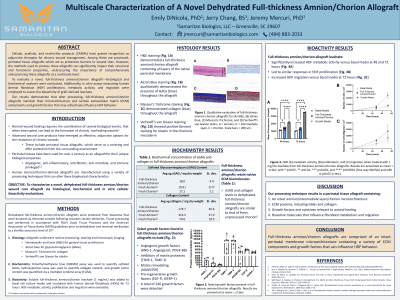
Cellular, acellular, and matrix-like products (CAMPs) have gained recognition as adjunctive therapies for chronic wound management. Among these are processed, perinatal tissue allografts which act as protective barriers to wound sites. However, the methods used to process these allografts can significantly impact their structural and functional properties, underscoring the importance of comprehensively characterizing these allografts at a multiscale level.
Methods:
Dehydrated, full-thickness amnion/chorion allografts* were produced from placentas that were donated via informed consent following cesarean section deliveries. Tissue processing was performed in accordance with Food and Drug Administration’s Good Tissue Practices and the American Association of Tissue Banks (AATB) guidelines prior to dehydration and terminal sterilization to a sterility assurance level of 10-6.
To evaluate the histological microarchitecture and extracellular matrix (ECM) composition of the resultant allografts*, samples underwent routine processing, staining and microscopic imaging. To biochemically characterize the allografts*, glycosaminoglycan (GAG), collagen, and growth factor content was quantified via a dimethylmethylene blue assay, hydroxyproline assay, and a multiplex cytokine array, respectively. To evaluate allograft* bioactivity, soluble extracts (1mg/ml) prepared from the grafts were added to basal cell culture media and incubated with human dermal fibroblasts (HDF’s). HDF metabolic activity, proliferation and migration were evaluated. Of note, all analyses were performed by independent, third-party vendors.
Results:
Allograft* histology demonstrated a full-thickness amnion/chorion allograft with a dense, intact ECM containing all zones of the native amnion, intermediate layer, and chorion while being comprised of collagen, glycosaminoglycan, and elastin. Average GAG content of the allograft* was 18.0±4.4 µg GAG/mg dry weight. Average collagen content of the allograft* was 179.7±46.6 µg collagen/mg dry weight. The allografts* contained 240 different species of growth factors, including those involved in ECM remodeling, angiogenesis and tissue regeneration. Furthermore, extracts from the allografts* supported enhanced fibroblast metabolism and migration compared to basal media controls.
Discussion:
The results herein demonstrate retention of native biophysical properties in this dehydrated, full-thickness amnion/chorion allograft*, where the allografts are comprised of an intact placental membrane microarchitecture containing a variety of ECM components and growth factors that can influence HDF behavior. These results also reveal preservation of the original relevant characteristics of the amnion/chorion relating to its utility to serve as a covering and offer protection from the surrounding environment.