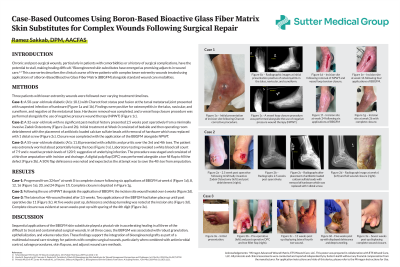
(CS-147) Accelerating Closure in Chronic DFUs: Healing Outcomes from a Six-Patient Borate-based Bioactive Glass Fiber Matrix (BBGFM) Case Series
Introduction: Diabetic foot ulcers (DFUs) remain a leading cause of lower-extremity morbidity, often characterized by prolonged healing trajectories, high recurrence rates, and risk for infection-related complications.1 Advanced wound matrices, including Borate-Based Bioactive Glass Fiber Matrix (BBGFM), have emerged as potential adjuncts to guideline-directed care by facilitating an optimal wound environment conducive to granulation and re-epithelialization.2 This case series evaluates outcomes following BBGFM application in six chronic DFUs with variable complexity, chronicity, and infection burden.
Methods: Six patients with chronic DFUs of at least 6 weeks’ duration were treated with BBGFM as an adjunct to standard evidence-based wound care. Data collected included patient age, wound location, chronicity, HbA1c, microbiologic or clinical infection status, timing of first BBGFM application, and time to complete epithelialization. All wounds were offloaded according to standard of care, and infection was managed per institutional protocols when present. Patients were followed until full closure, defined as 100% epithelialization without drainage.
Results: The mean patient age was 68.5 years and mean wound chronicity prior to first BBGFM application was 15.86 weeks. Average HbA1c across the cohort was 7.52, reflecting generally moderate glycemic control. Three of six patients demonstrated infection or osteomyelitis at presentation. BBGFM was initiated at varying points in the treatment course (range: 0–12 weeks), with an average initiation point of 6 weeks into care. Following the first application, the mean time to complete wound healing was 12.43 weeks. Individual time-to-closure ranged from 5.5 to 26 weeks, with earlier BBGFM application appearing qualitatively associated with shorter healing durations in several cases. Notably, both Charcot-related ulcers and amputation-site wounds demonstrated favorable trajectories following matrix application, even in cases with documented bone involvement.
Discussion: In this six-patient case series of chronic, complex DFUs, half of which presented with active infection, adjunctive use of BBGFM was associated with consistent wound closure, with an average healing time of 12.43 weeks after first application. These findings support the potential value of BBGFM in managing recalcitrant DFUs.

.jpg)