
.jpg)
Case Series/Study
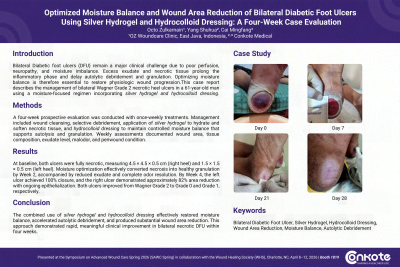
Bilateral Diabetic foot ulcers (DFU) remain a major clinical challenge due to poor perfusion, neuropathy, and moisture imbalance. Excess exudate and necrotic tissue prolong the inflammatory phase and delay autolytic debridement and granulation. Optimizing moisture balance is therefore essential to restore physiologic wound progression.This case report describes the management of bilateral Wagner Grade 2 necrotic heel ulcers in a 61-year-old man using a moisture-focused regimen incorporating silver hydrogel and hydrocolloid dressing.
Methods:
A four-week prospective evaluation was conducted with once-weekly treatments. Management included wound cleansing, selective debridement, application of silver hydrogel to hydrate and soften necrotic tissue, and hydrocolloid dressing to maintain controlled moisture balance that supports autolysis and granulation. Weekly assessments documented wound area, tissue composition, exudate level, malodor, and periwound condition.
Results:
At baseline, both ulcers were fully necrotic, measuring 4.5 × 4.5 × 0.5 cm (right heel) and 1.5 × 1.5 × 0.5 cm (left heel). Moisture optimization effectively converted necrosis into healthy granulation by Week 2, accompanied by reduced exudate and complete odor resolution. By Week 4, the left ulcer achieved 100% closure, and the right ulcer demonstrated approximately 82% area reduction with ongoing epithelialization. Both ulcers improved from Wagner Grade 2 to Grade 0 and Grade 1, respectively.
Discussion:
The combined use of silver hydrogel and hydrocolloid dressing effectively restored moisture balance, accelerated autolytic debridement, and produced substantial wound area reduction. This approach demonstrated rapid, meaningful clinical improvement in bilateral necrotic DFU within four weeks.