
.jpg)
Clinical Research
Nearly 18.6 million people worldwide develop a diabetic foot ulcer (DFU) annually1.
DFUs are a major diabetes complication, drive hospitalizations, precede lower-extremity
amputations, and increase mortality risk.1 Although DFU care standards are established,
practice varies due to inconsistent dressing use and limited comparative evidence for
advanced products. This Phase IV, multicenter, randomized clinical trial evaluated the
effectiveness, usability, and resource implications of transforming powder dressing (TPD)
compared with standard-of-care (SOC) dressings for treatment of chronic DFUs.
Methods:
Adults with Wagner grade 1–2 DFUs were randomized 1:1 to TPD or SOC at 11
U.S. sites with weekly follow-up for 12 weeks or until closure. The aim was to assess
whether TPD could reduce wound management burden without adversely impacting clinical
outcomes. The primary endpoint was complete re-epithelialization sustained for two
consecutive visits; secondary endpoints included wound area reduction (WAR), dressingchange
frequency, debridement needs, recurrence, and usability.
Results:
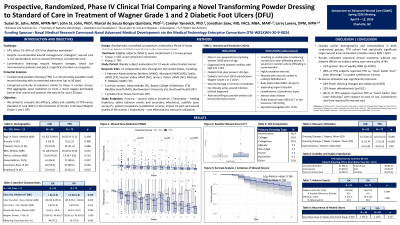
135 participants were enrolled (mean age 62 years; 87% male).
Baseline wound size was significantly larger in the TPD arm (~80% greater median wound
area vs. SOC). Despite this, wound closure rates by Week 12 were comparable between
groups. TPD achieved significantly greater weekly WAR (51% relative improvement; p =
0.002), reduced dressing changes by 67% (p < 0.001), and required 33% fewer
debridements (p = 0.01). Pain scores during dressing changes were 59% lower in the TPD
cohort (p = 0.02) patient satisfaction favored TPD, with >80% reporting superior ease,
comfort, and convenience.
Discussion:
The TPD cohort demonstrated accelerated WAR, markedly lower treatment
burden, and high user satisfaction, supporting its potential as an efficient, patient-centered
option for DFU management across diverse clinical environments.