(CS-162) Evaluation of Efficacy for a Hydrocapillary Dressing (XLTA) on the Treatment of Burn Wounds: A Prospective Cohort Study from South African Tertiary Burn Center
Friday, April 10, 2026
Kobie Mouton, J.D. – Partner, Xlta Cure
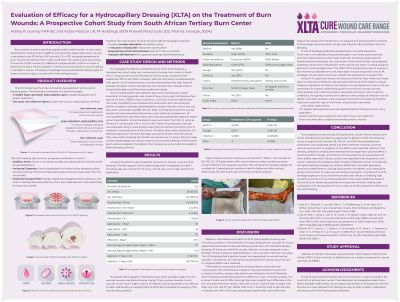
Introduction: Burn wounds remain a significant global health burden, with healing trajectories influenced by exudate levels, bioburden, and the ability to maintain an optimized wound microenvironment. Hydrocapillary, hydroconductive dressings offer potential advantages in managing highly exudative burns by supporting autolytic debridement, moisture balance, and reduction of slough and biofilm. The topical dressing is a tri-layer construct engineered to wick fluid via capillary action, disperse exudate horizontally, and attract negatively charged pathogens and proteases through positively charged fibers. This retrospective cohort study evaluated the clinical performance of a topical hydrocapillary, hydroconductive dressing in burn wounds treated at a tertiary burn center in South Africa.
Methods: A total of 62 patients with partial- or full-thickness burn wounds were enrolled between September 2021 and July 2024. Approval to conduct the study was obtained from the Health Research Ethics Committee (HREC) of the University of Stellenbosch under Biobank Approval ID #32614. Demographic variables included age, sex, mechanism of injury, wound age, total body surface area (TBSA), time to dressing application, and injury location. Ten wound assessment parameters were evaluated before and after treatment: biofilm, exudate, moistness, epithelialization, slough, infection, color, size, site, odor, and swab need (BE, ME, SIC, SOS). All assessments were completed by the attending physician using visual interpretation and standardized wound photography. Pre–post changes were analyzed using McNemar’s Chi-square test.
Results: Post-treatment results demonstrated improvement across all wound assessment categories. All instances of biofilm, slough, infection, and odor resolved following treatment, with statistically significant reductions in biofilm, slough, and infection (p < 0.05). Exudate management was uniformly effective, and epithelialization, moisture balance, and tissue quality improved in all cases. No adverse events related to the dressing were reported.
Discussion: These findings support this hydrocapillary dressing as an effective option for managing high-exudate burn wounds, promoting autolytic debridement, reducing bioburden, and enhancing overall wound progression. Further controlled, quantitative studies comparing Xlta™ to standard care are recommended.

.jpg)