(HE-006) Health resource utilization and cost analysis of Porcine Placental Extracellular Matrix compared to standard of care and other advanced treatments in the treatment of venous leg ulcers in the Medicare Fee-For-Service population
Introduction: Venous Leg Ulcers (VLU) have significant economic costs and profound negative health outcomes. This study compares health resource use and cost in the Medicare population receiving Porcine Placental Extracellular Matrix (PPECM)* to patients receiving standard of care (SOC)‡ and other advanced treatments (AT)†.
Methods: Medicare Research Identifiable Files, which contain 100% of Medicare Fee-For-Service Parts A and B claims were assessed from 2021 through 2024. Patients with a newly diagnosed VLU were identified. Their treatment episodes were categorized as either: PPECM, SOC, or AT. Upon treatment conclusion, the patients’ utilization and spending were assessed across all Medicare Parts A and B care sites. Pre-index clinical and demographic differences were controlled via inverse probability treatment weighting. Adjusted cohorts were analyzed using weighted regression models to estimate differences in predicted spending and utilization across treatment groups and care settings.
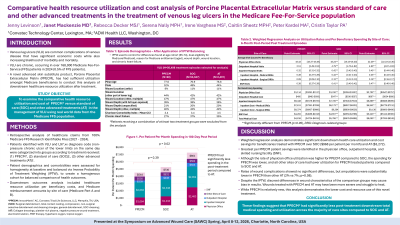
Results: 60 VLU PPECM treatment episodes were selected to compare to the other groups (SOC = 53,947; AT = 2,491). Total medical care costs in the post-treatment window were not significantly different compared to SOC but were significantly lower than AT ($4,690 vs. $7,463, p=0.02). PPECM was associated with significantly lower utilization rates in outpatient hospitals, intensive care units, and emergency rooms, with no site showing increased utilization. Weighted regression analyses found PPECM had significantly lower rates of utilization across every site except home health. PPECM was associated with reduced per beneficiary spending in physician offices, outpatient hospitals, and skilled nursing facilities, with lower total medical spending across all sites. Rates of wound complications showed no significant differences, but amputations were substantially lower in PPECM than other AT (2% vs 7%; p=0.08).
Discussion: This real-world analysis reveals PPECM treatment delivers favorable clinical value for VLU patients, reducing both downstream healthcare utilization and spending compared to SOC and alternative ATs.

.jpg)