
.jpg)
Clinical Research
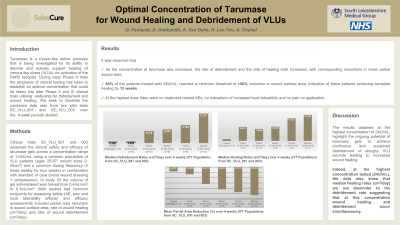
Tarumase is a trypsin-like serine protease that is being investigated for its ability to debride and actively support healing of venous leg ulcers (VLUs) via activation of the PAR2 receptor. During early Phase II trials the emphasis of clinical testing has been to establish an optimal concentration that could be taken into later Phase II and III clinical trials utilising co-primary endpoints for debridement and wound healing. We seek to illustrate the combined data sets from two pilot trials SC_VLU_001 and 003 over the 4 week periods studied. It was observed that as the concentration of tarumase was increased, the rate of debridement and the rate of healing both increased, with corresponding reductions in mean partial wound area. Indeed, 75% of the patients treated with 24U/mL, reached a minimum threshold of >40% reduction in wound surface area, indicative of these patients achieving complete healing by 12 weeks. At the highest dose there were no treatment related AEs, no indications of increased local tolerability and no pain on application. The results obtained at the highest concentration of 24U/mL, highlight the ongoing potential of tarumase gels to achieve continuous and sustained debridement of sloughy VLU wounds leading to increased wound healing. Surprisingly, at the highest concentration tested (24U/mL), the data also show that median healing rates (cm2/day) exceed the debridement rates (cm2/day) by a factor of 2.5, suggesting that at this concentration the wound healing effects may be greater than the potential debridement effects.
Methods: Clinical trials SC_VLU_001 and 003 assessed the clinical safety and efficacy of tarumase gels across a concentration range of 1-24U/mL using a common population of VLU patients (ages 25-87; wound sizes 2-45cm2) and a common dosing frequency (3 times weekly for four weeks) in combination with standard of care (moist wound dressing + compression). In study 03 the volume of gel administered was halved from 0.4mL/cm2 to 0.2mL/cm2. Both studies had common endpoints for assessing safety (AE, pain and local tolerability effects) and efficacy assessments included partial area reduction in wound surface area, rate of wound healing (cm2/day) and rate of wound debridement (cm2/day).
Results:
Discussion: