
.jpg)
Practice Innovations
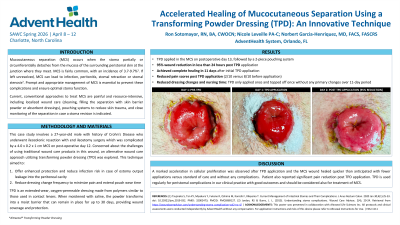
Mucocutaneous separation (MCS), a detachment of stoma from peristomal skin, affects 3.7–9.7% of patients.¹ Without treatment, it can cause infection, peritonitis, or stomal complications.² Management is essential but current care is painful and labor-intensive, requiring local wound care, absorbent products, and close monitoring.
Methods:
We present four patients with MCS treated with an extended wear transforming powder dressing (TPD) either initially or after failing standard of care (SOC). Given the limitations of traditional wound products, TPD was explored to: (1) protect against ostomy output leakage into the peritoneal cavity and (2) reduce dressing changes to lessen pain and extend pouch wear. TPD forms an oxygen-permeable moist barrier when hydrated and can remain in place for up to 30 days.
1. 27 y/o male with history of Crohn’s Disease who underwent ileocolonic resection with end ileostomy surgery, complicated by (c/b) a 4.0 x 0.2 x 1 cm MCS on post-operative day 12.
2. 64 y/o male with complicated abdominal surgical history (hernia repair, colonic malignancy, colectomy, colostomy) who developed a perforated colon, and underwent exploratory laparotomy, colon resection, transverse colostomy c/b 3.5 cm deep MCS.
3. 62 y/o female with metastatic ovarian cancer who underwent rectosigmoid resection/colostomy and developed MCS 1 cm depth (2-8 o'clock).
4. 87 y/o female s/p total abdominal colectomy and creation of ostomy c/b circumferential MCS 0.8cm deep
< !
Results:
1. TPD was applied in the MCS on postoperative Day 13, followed by a 2-piece pouching system. Less than 24 hours later, the wound had reduced by 95%. TPD was applied once, topped off once, before complete healing 11 days later.
2. After 4 days of SOC without improvement, TPD was applied and MCS healed in 17 days with three applications of TPD.
3. TPD was applied and topped off every 2-4 days with appliance changes. Healed in 6 weeks.
4. MCS healed in 13 days with two TPD applications.
Discussion:
MCS wounds healed faster than anticipated with no complications. Nursing time and dressing changes were reduced with TPD versus SOC. Together with TPD’s success in other peristomal wounds, these results support its consideration for MCS management.