(PI-033) Transforming Wound Management: Clinical and Workflow Improvement in Acute Care Settings
Friday, April 10, 2026
Jeffrey Chiu, MD, MD – Surgeon, Department of Surgery, AdventHealth Orlando; Kimberly Klein, MSN, RN, PCCN, NPD-BC – Nursing Outcomes Program Manager, CFD Nursing, AdventHealth Orlando
Introduction: Nearly half of hospitalized patients have wounds requiring frequent, painful dressing changes, often prolonging hospital stays and increasing readmissions, creating a need for efficient solutions that lessen nursing workload while improving healing outcomes.
Methods: A large United States (US) academic hospital system piloted an extended wear (< 30 days) novel transforming powder dressing (TPD) in effort to improve outcomes related to wound healing rates, pain levels, dressing frequency, complications, and nursing time. Evaluations encompassed acute and chronic wounds: two quality improvement (QI) projects for post‑operative wounds, a randomized controlled trial (RCT) for diabetic foot ulcers (DFUs), a retrospective review of recalcitrant pressure injuries, and a nursing efficiency study.
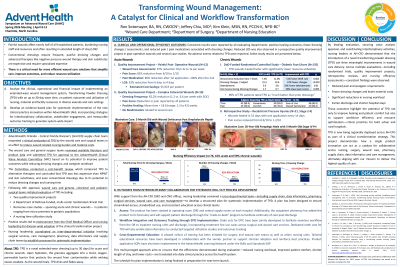
Results: TPD demonstrated consistent clinical and operational improvements. In a QI studyof general surgery patients (n=12), patients experienced an pain and related medications decreased by 80+%; wound assessments by 66%/week. A colorectal QI study (n=10) similarly showed reduced pain, with a 78% reduction in dressing frequency. All patients healed without readmissions in both studies. A retrospective pressure injury study (n=21) documented complete healing of Stage 2–4 pressure injuries previously unresponsive to standard care with 11 total applications. In a RCT involving 135 DFU patients, TPD patients experienced 51% faster wound area reduction with 67% fewer dressing changes and 59% lower pain scores. A nursing efficiency study (n=76) across wound etiologies showed weekly dressing time decreased from 2.6 hours per patient to < 20 minutes. No product‑related complications were reported in across studies.
Discussion: TPD is now being deployed regionally across this hospital system as part of a broader strategy to enhance outcomes, shorten length of stay, reduce costs, and optimize nursing workflow.

.jpg)