
.jpg)
Clinical Research
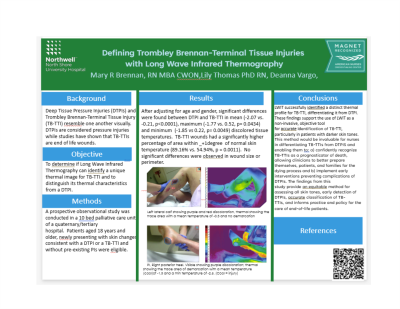
A prospective observational study was conducted in a 10-bed palliative care unit of a quaternary hospital. Patients aged 18 or older, newly presenting with skin changes consistent with DTPI or TB-TTI and without pre-existing pressure injuries, were eligible. Infrared thermographic imaging was performed using the Long Wave Infrared Thermography device to capture thermal and visual images of affected and adjacent skin. Temperatures and wound dimensions were analyzed.
Results:
After adjusting for age and gender, significant differences were found between DTPI and TB-TTI in mean (-2.07 vs. -0.21, p< 0.0001), maximum (-1.77 vs. 0.52, p=0.0434), and minimum (-1.85 vs. -0.22, p=0.0049) discolored tissue temperatures. TB-TTI wounds had a significantly higher percentage of area within ±1°C of normal skin temperature (89.16% vs. 54.94%, p=0.0011) compared to the adjacent tissue. No significant differences were observed in wound size or perimeter.
Discussion: LWIT successfully identified a distinct thermal profile for TB-TTI, differentiating it from DTPI. This work will add to much needed scientific knowledge and will enable clinicians to identify TB-TTIs and validate their assessments with a simple, objective, quantitative, non-invasive, and easy to use screening tool, particularly beneficial for darkly pigmented skin tones.