
.jpg)
Case Series/Study
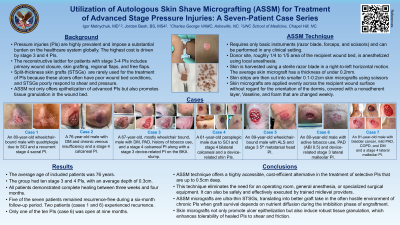
Pressure injury (PI) wounds are highly prevalent and impose a substantial burden on the healthcare system globally. The application of micrografting techniques for the management of advanced-stage pressure injuries is an area of emerging interest, with a notably limited body of clinical literature. We aim to present a case series of 7 patients who were successfully treated with the skin shave micrografting technique, developed and previously published by the authors.
Methods:
Between 2024 and 2025, 7 patients with Stage III or IV PIs were treated using an autologous skin shave micrografting approach. Patients were treated weekly in different clinical settings (hospital, rehabilitation center, and ulcer clinic). All traditional PI-related treatment measures (nutrition optimization, offloading, shear control, etc.) were implemented, and pressure ulcers were sharply debrided before skin grafting. PIs were photographed and measured at each visit.
Results:
A total of 7 patients with 10 pressure injuries, two stage III and eight stage IV, underwent autologous skin shave micrografting. The average PI size was 7.2 cm2, and the average depth was 0.3 cm. The average donor site was 1.5 cm2. All patients demonstrated complete healing within 4 months. Five of seven patients remained recurrence-free during a six-month follow-up period, and only one out of ten ulcers was open at six months.
Discussion:
Autologous skin shave micrografting is a practical and effective method for treating select advanced pressure injuries. We demonstrate that using the skin shave micrografting technique enables grafts only a fraction of a millimeter thick to fill PIs up to 0.3 cm deep after a single application. Autologous skin shave micrografting is a promising modality for the treatment of select pressure injuries and should be considered as part of the reconstructive ladder for advanced pressure injuries.