
.jpg)
Practice Innovations
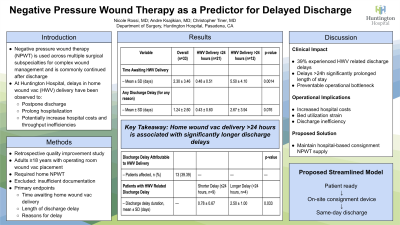
This retrospective quality improvement study included adults ≥18 years who underwent operating room wound vac placement and required a home NPWT device between November 1, 2022 and December 31, 2025. Patients were excluded if they received a Prevena device, had insufficient documentation, or had devices delivered directly to facilities.
Primary endpoints included time awaiting home wound vac delivery, length of discharge delay, and reasons for delay. Values are reported as mean ± SD, and continuous variables were analyzed using Welch’s t-test.
Results:
33 patients met our inclusion criteria. The average time awaiting home wound vac delivery was 2.3 days. 21 patients received a device within 24 hours (0.48 ± 0.51 days), while 12 waited >24 hours (5.50 ± 4.10 days; p = 0.0014). Patients with delivery times >24 hours experienced longer discharge delays for any reason (2.67 ± 3.94 days) than those with earlier delivery (0.43 ± 0.60 days; p = 0.076).
13 patients had discharge delays directly attributable to late device delivery. Among these, 4 patients experienced discharge delays >24 hours, with an average delay of 2.5 ± 1.00 days compared with 0.78 ± 0.67 days in those with shorter delivery delays (p = 0.033). The average time awaiting device delivery in patients with >24 hour discharge delays was 3 days.
Discussion: Delayed home wound vac delivery was associated with prolonged delivery times and extended discharge delays. Delays exceeding 24 hours represent a threshold at which discharge is significantly impacted, suggesting a target for intervention. Documentation limitations reduced sample size and generalizability. Despite this, our findings highlight operational gaps in home NPWT coordination and support exploring solutions such as maintaining a hospital-based consignment supply to reduce delays and improve patient flow.