
.jpg)
Laboratory Research
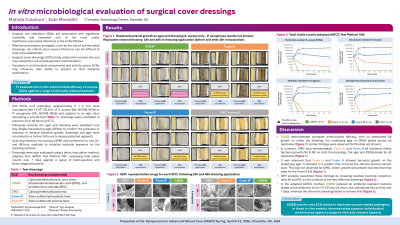
Surgical site infections (SSIs) are associated with significant morbidity and are among the most costly healthcare-associated infections in the United States. Once established, wound infections can be difficult to treat, highlighting the importance of effective preventative strategies (e.g., use of antimicrobial dressings). This study evaluated the in vitro antimicrobial efficacy of various surgical cover dressings (SCDs) against a range of clinically relevant bacteria.
Methods:
Four SCDs were assessed: two carboxymethylcellulose (CMC) fiber dressings (one containing ionic silver, ethylenediaminetetraacetic acid [EDTA], and benzethonium chloride [BEC], referred to as ‘CISEB’*, and one composed of CMC alone, referred to as ‘CMC’†), as well as two silver-containing foam dressings (‘Foam A’‡ and ‘Foam B’§). Each dressing (approximately 5×5 cm) was inoculated with 1×10⁶ colony-forming units/mL (CFU/mL) of S. aureus (NCIMB 9518) or P. aeruginosa (NCIMB 8626) and applied to an agar slice simulating a wound bed. Dressings were incubated in place for 48 hours at 37°C. After removal, the agar was re-incubated and swabbed onto Dey-Engley Neutralizing Agar to assess residual bacterial growth. Each dressing was tested in triplicate. Scanning electron microscopy (SEM) was performed to visualize bacterial presence on the dressing surfaces. Additionally, dressings were tested in an adapted AATCC Test Method 100, to establish the total viable counts over 7 days against a range of Gram-positive and negative bacteria.
Results:
CISEB demonstrated complete antimicrobial efficacy, with no detectable S. aureus growth on either the dressing or the underlying agar across all replicates. In contrast, CMC (non-antimicrobial), Foam A, and Foam B all exhibited visible bacterial growth on both the dressings and the agar in all replicates. Foam A failed to eliminate the inoculated bacteria, as evidenced by consistent growth patterns. SEM analysis supported these findings by revealing residual bacterial presence on the surfaces of the less effective dressings. In the adapted AATCC method, CISEB reduced all tested bacteria to the detection limit by 24 hours, whereas the other test dressings failed to achieve this.
Discussion:
CISEB was the only tested product to achieve complete bacterial kill in these in vitro models, demonstrating superior antimicrobial performance against a range of clinically relevant bacteria. The combination of ionic silver, EDTA, and BEC may contribute to its enhanced efficacy and support the potential clinical value of multi-agent antimicrobial dressings in reducing the risk of SSIs. Further in vivo studies are warranted to confirm these results and assess their clinical relevance.