
.jpg)
Clinical Research
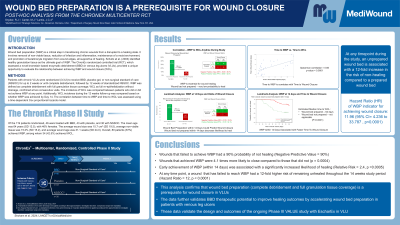
Wound bed preparation (WBP) is a critical step in transitioning chronic wounds from a disrupted to a healing state. It involves removal of non-viable tissue, reduction of infection and inflammation, maintenance of a moist environment, and promotion of keratinocyte migration from wound edges, all supportive of healing. Schultz et al. (2003) identified healthy granulation tissue as the ultimate goal of WBP. The ChronEx randomized controlled trial (RCT), which assessed a novel bromelain-based enzymatic debridement (BBD) in venous leg ulcers (VLUs), provided a unique opportunity to evaluate the relationship between achieving WBP and wound closure (WCL).
Methods: Patients with chronic VLUs were randomized (3:3:2) to receive BBD, placebo gel, or non-surgical standard of care (NSSOC) for up to 2 weeks or until complete debridement, followed by 12 weeks of standardized NSSOC. WBP was defined as complete debridement with full granulation tissue coverage; WCL as full re-epithelialization without drainage, confirmed at two consecutive visits. The incidence of WCL was compared between patients who did or did not achieve WBP at any point. Additionally, WCL incidence during the 12 weeks follow-up was compared based on whether WBP was achieved by Day 14. The correlation between time to WBP and time to WCL was assessed using a time-dependent Cox proportional hazards model.
Results: Of 119 randomized patients, 80 (67%) achieved WBP. Among them, 34 (42.5%) achieved WCL, compared to only 4 of 39 (10.3%) who did not (Relative Risk [RR] = 4.1; p = 0.0004). Wounds that failed to achieve WBP had a 90% probability of non-healing. Early WBP (by Day 14) significantly improved healing likelihood (50.0% vs. 22.7%; RR = 2.4; p = 0.0005). Time-to-event analysis showed a 12-fold increased likelihood of remaining unhealed when WBP was not achieved (Hazard Ratio = 12.0; p < 0.0001).
Discussion: This analysis confirms that wound bed preparation is a prerequisite for wound closure in VLUs. Wounds that fail to achieve WBP rarely proceed to healing, underscoring its critical role in chronic wound management.