
.jpg)
Clinical Research
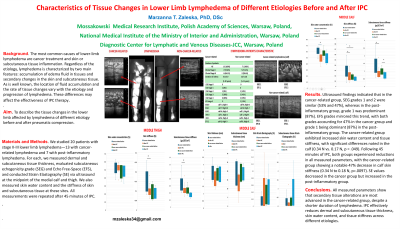
The most common causes of lower limb lymphedema are cancer treatment and inflammation of the skin or subcutaneous tissues. Regardless of the etiology, lymphedema is characterized by two main features: accumulation of edema fluid in tissues and secondary changes in the skin and subcutaneous tissue. The location of fluid buildup and the rate of tissue changes vary depending on the etiology and progression of lymphedema. These differences may affect the effectiveness of IPC therapy.
Aim
To describe the tissue changes in the lower limb affected by lymphedema of different etiology before and after pneumatic compression.
Methods:
We studied 20 patients with stage II-III lower limb lymphedema—13 with cancer-related lymphedema and 7 with post-inflammatory lymphedema. For each, we measured dermal and subcutaneous tissue thickness, evaluated subcutaneous echogenicity grade (SEG) and Echo Free-Space (EFS), and conducted Strain Elastography (SE) via ultrasound at the midpoint of the medial calf and thigh. We also measured skin water content and the stiffness of skin and subcutaneous tissue at these sites. All measurements were repeated after 45 minutes of IPC.
Results:
Ultrasound findings indicated that in the cancer-related group, SEG grades 1 and 2 were similar (53% and 47%), while the post-inflammatory group showed a predominance of grade 1 (87%). EFS grades mirrored this trend, with both grades accounting for 47% in the cancer group and grade 1 being dominant (87%) in the post-inflammatory group. The cancer-related group exhibited increased skin water content and tissue stiffness, with significant differences noted (0.34 N vs. 0.17 N, p=.049 in the calf). Following 45 minutes of IPC, both groups experienced reductions in all measured parameters, with the cancer-related group showing a notable 47% decrease in calf skin stiffness (0.34 N to 0.18 N, p=.0097). SE values decreased in the cancer group but increased in the post-inflammatory group.
Discussion:
All measured parameters show that secondary tissue alterations are most advanced in the cancer-related group, despite a shorter duration of lymphedema. IPC effectively reduces dermal and subcutaneous tissue thickness, skin water content, and tissue stiffness across different etiologies.