
.jpg)
Case Series/Study
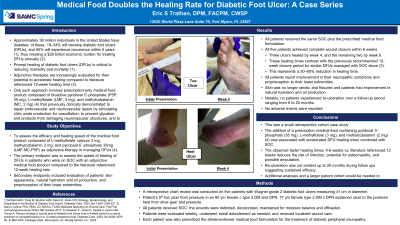
Introduction: Prompt healing of diabetic foot ulcers (DFUs) is critical to reducing morbidity and mortality. Approximately 38 million individuals in the United States have diabetes; of these, 19–34% will develop DFUs, and 65% will experience recurrence within 5 years (1). The economic burden of DFU treatment exceeds $28 billion annually (2). Adjunctive therapies are increasingly evaluated for their potential to accelerate healing. One such approach involves prescription-only medical food composed of bioactive pyridoxal 5’-phosphate (35 mg), L-methylfolate (3 mg), and methylcobalamin (2 mg) (4). This medical food formulation helps repair endovascular and neurovascular layers by stimulating nitric oxide production for vasodilation, preventing glycation end products from damaging neurovascular structures, and promoting remyelination of damaged nerves.
Methods:
Methods: A retrospective chart review was conducted on five patients with Wagner grade 2 diabetic foot ulcers measuring ≥1 cm in diameter. All patients received standard of care: the wounds were debrided, decolonized, maintained for moisture balance and offloaded. They were evaluated weekly, underwent serial debridement as needed, and received localized wound care. Each patient was also prescribed the aforementioned medical food formulation for the treatment of diabetic peripheral neuropathy.
Results:
Results: All five patients achieved complete wound closure within 6 weeks. All received the same standard of care plus the prescribed medical food formulation. Three ulcers healed by week 4, and the remaining two by week 6. These healing times contrast with the previously recommended 12-week closure period for similar DFUs managed with standard care alone (3). This represents a 50–60% reduction in healing time. No adverse events were reported.
Discussion:
Discussion: In this small retrospective cohort, the addition of a prescription medical food containing pyridoxal 5’-phosphate (35 mg), L-methylfolate (3 mg), and methylcobalamin (2 mg) was associated with accelerated DFU healing when combined with standard wound care. The observed faster healing times, 4-6 weeks vs. literature referenced 12 weeks reduces the risk of infection, potential for osteomyelitis, and possible amputation. Notably, no patients experienced re-ulceration over a follow-up period ranging from 6 to 20 months. Additional analyses and a larger patient cohort would be needed to determine a possible causal relationship.