
.jpg)
Clinical Research
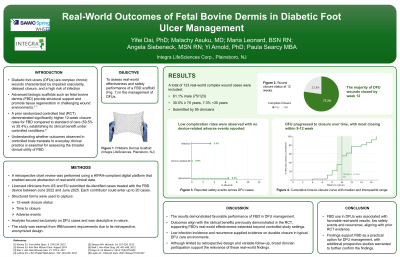
A total of 123 DFU cases were collected and analyzed. Complete wound closure at 12 weeks was achieved in 77.2% of cases (95/123). Safety outcomes were favorable: no intraoperative device-related adverse events were reported. Infection complications occurred in 3.3% of cases, and wound recurrence was noted in 6.5%, primarily within six months.
Discussion: This chart review highlights consistent real-world performance of FBD in DFU management across US and EU practices. Real-world DFU outcomes confirm the clinical benefits of FBD observed in controlled trials. Outcomes observed in routine care align closely with those reported in controlled trials, supporting the clinical benefits of FBD beyond the constraints of RCT settings. Compared to prior RCT data1, this study demonstrates comparable effectiveness in the real-world setting, achieving high closure rates with minimal complications. Low infection incidence (3.3%) and modest recurrence (6.5%) suggest durable healing and potential to reduce downstream risks such as hospitalization and amputation. While retrospective design and variable follow-up are limitations, these findings reinforce FBD as a reliable, versatile option for complex diabetic wounds and underscore its potential role in cost-effective, multidisciplinary limb-preservation strategies.