
.jpg)
Case Series/Study
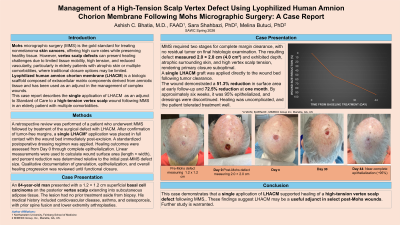
Mohs micrographic surgery (MMS) for nonmelanoma skin cancer can result in postoperative defects that are challenging to manage, particularly on the scalp vertex where high tension, limited tissue mobility, and reduced vascularity may impair healing. Lyophilized Human Amnion Chorion Membrane (LHACM) is a tri-layer placental allograft composed of amnion, intermediate, and chorion layers, preserving its native extracellular matrix and more than 300 naturally occurring regulatory proteins. LHACM has shown promise in facilitating closure of complex wounds; however, data describing its use in post-Mohs defects remain limited. The objective of this report is to describe the healing trajectory of a high-tension scalp vertex defect treated with a single application of LHACM following MMS.
Methods: A retrospective clinical review was performed on an 84-year-old male with cardiovascular disease, a history of hip and knee replacements, asthma, and osteoporosis who underwent MMS for a superficial basal cell carcinoma of the scalp vertex. Wound measurements, photographic records, and postoperative clinical notes were evaluated from Day 0 through complete epithelialization. LHACM was applied once on Day 0, followed by a standardized dressing protocol. Wound area and percent reduction were calculated at each follow-up visit.
Results: The post-Mohs defect measured 2.0 × 2.0 cm (4.0 cm²) on Day 0. Following a single LHACM application, the wound contracted to 1.5 × 1.3 cm (1.95 cm²; 51.3% reduction) by Day 8, and to 1.0 × 1.1 cm (1.10 cm²; 72.5% reduction) by Day 30. By Day 44, the wound was approximately 95% epithelialized (0.20 cm²), requiring no further wound care. Healing was uncomplicated, and no additional biologic applications or surgical interventions were needed.
Discussion: A single application of LHACM supported rapid and progressive healing of a high-tension scalp vertex defect following MMS in an elderly patient with multiple comorbidities. Significant wound size reduction and near-complete epithelialization by six weeks suggest that LHACM may serve as a valuable adjunct for optimizing outcomes in post-Mohs defects where traditional closure options are limited. Larger studies are warranted to better define its role in dermatologic surgery.