
.jpg)
Case Series/Study
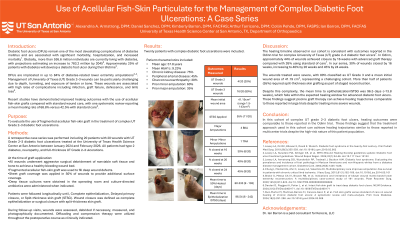
Chronic diabetic foot ulcerations (DFUs) remain a significant cause of morbidity and limb loss. Deep or irregularly contoured wounds with exposed tendon, capsule, or bone present particular reconstructive challenges. Biologic dermal substitutes have improved healing outcomes in selected cases, but there is limited evidence addressing particulate formulations specifically designed for complex wound geometries. Acellular fish-skin matrices possess structural and biologic properties favorable for tissue regeneration, including intact collagen architecture and naturally occurring omega-3 fatty acids that promote resolution of chronic inflammation. A particulate form allows direct contact with irregular or tunneled wound beds. This study presents an updated institutional case series expanding on prior published work, evaluating outcomes following use of acellular fish-skin particulate in complex diabetic UT grade 2 and 3 foot ulcerations within a tertiary academic limb salvage program.
Methods:
A retrospective review was conducted of patients with diabetic lower-extremity ulcerations treated with acellular fish-skin particulate between January 2023 and October 2025. All patients underwent sharp debridement prior to application, with particulate material used to fill depth and undermined areas. Wound progression was documented at each visit. The primary outcome was time to complete epithelialization; secondary outcomes included granulation quality, percent wound reduction, and complication rates.
Results:
Preliminary review demonstrates consistent granulation and progressive wound contraction across a spectrum of deep and irregular ulcerations. Early findings suggest successful soft-tissue coverage in many cases without flap reconstruction or negative pressure therapy.
Discussion:
Acellular fish-skin particulate appears to be a promising adjunct for managing complex DFUs with depth or exposed structures. Its ability to conform to irregular wound geometries may facilitate closure, decrease reliance on more invasive reconstructive options, and support cost-conscious, value-based limb preservation strategies. Further prospective study is warranted.