
.jpg)
Practice Innovations
Introduction
Each year, ~2.5 million patients develop pressure ulcers/injuries (PUs/PIs), resulting in ~60,000 deaths and ~$11 billion in treatment costs. The Centers for Medicare & Medicaid Services (CMS) lists PUs/PIs among 14 hospital-acquired conditions. While hospitals already face payment reductions for Stage 3-4 PUs/PIs, CMS recently added Stage 2 PUs/PIs as reportable “harms” with mandatory reporting starting in 2027. Despite established prevention guidelines and bundles, avoidable hospital-acquired pressure injuries (HAPIs) persist. To enhance wound care clinician-led education and ensure continuous evidence-based support for staff nurses, we aimed to develop a HAPI Frequently Asked Questions (HAPI-FAQ) library - a curated, reliable resource integrated within a clinical decision-support platform.
Methods:
Methods
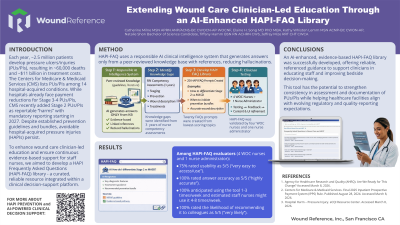
HAPI-FAQ leverages an AI-powered clinical intelligence system that generates answers exclusively from information within a peer-reviewed knowledge base with linked references and thereby reduces erroneous or inaccurate hallucinatory AI responses. Twenty FAQ prompts were developed based on the lowest-scoring topics from three years of nurse competency assessments, and focused on staging, prevention methods, wound description, and treatments. Four WOC nurses and one nurse administrator tested the tool and provided feedback, which informed refinements to content/user interface.
Results:
Results
Seventy-five percent of evaluators rated usability as 5/5 (“very easy to access/use”) and all rated answer accuracy as 5/5 (“highly accurate”). Participants anticipated using the tool 1-3 times/week and estimated staff nurses might use it 4-8 times/week. All respondents rated the likelihood of recommending it to colleagues as 5/5 (“very likely”).
Discussion:
Discussion
An AI-enhanced, evidence-based HAPI-FAQ library was successfully developed, offering reliable, referenced guidance to support clinicians in educating staff and improving bedside decision-making. This tool has the potential to strengthen consistency in assessment and documentation of PUs/PIs while helping healthcare facilities align with evolving regulatory and quality-reporting expectations.