(LR-032) Positive Pressure Measurements Underneath Negative Pressure Wound Therapy Dressings: A Comparison of Foam and a Novel Polymer Dressing
Friday, April 10, 2026
Meera Dhodapkar, MD, MPH – resident, Orthopedics, The Mayo Clinic; Mitchell Greenberg, MBA, MEng – Associate Investigator, The Geneva Foundation; Brett Freedman, MD – Orthopedic Spine surgeon- Chair, Orthopedics, The Mayo Clinic
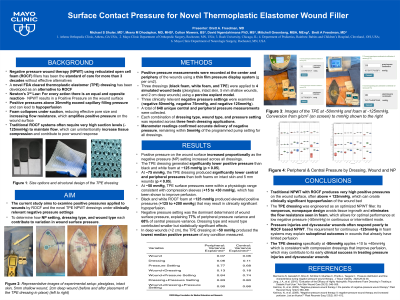
Introduction: Based on Newton’s third law, for every action there is an equal and opposite reaction, negative pressure wound therapy (NPWT) applies positive pressure (PP) to the wound surface.A novel, pliable, transparent, thermoplastic elastomer (TPE) dressing has been developed and FDA-cleared. The dressing was designed to improve flow characteristics, inhibit tissue ingrowth and provide NPWT at lower pressures. The current study aims to examine PP applied to wounds by reticulated open cell foam (ROCF) and the novel TPE dressings under clinically relevant levels of negative pressure (NP).
Methods: Three dressings (black foam (BF), white foam (WF) and the TPE) were applied on 4 different simulated wound beds (plexiglass, intact skin, 5mm depth shallow wounds and 2cm deep intramuscular wounds). Swine porchetta specimens were utilized for wound models. Three pressure settings were examined (-50mmHg, -75mmHg and -125mmHg). Each configuration or dressing, wound type and setting was repeated with three dressing applications. Each application was recorded 3 times. PP measurements were recorded at the center and periphery of the wounds using a thin film pressure display system.
Results: PP increased as the vacuum NP setting increased in all dressings.The TPE transduces significantly lower PP at -125 mmHg for all wounds compared to BF and WF. (p< 0.05)The TPE demonstrates significantly lower PP at -75 mmHg for intact skin and 5 mm wounds versus BF and WF. (p< 0.05)At -50mmHg, the TPE surface PP was consistent with therapeutic compression sleeves (+15 to +35mmHg). The BF and WF at -125mmHg showed potentially dangerous PP (+125 to +200mmHg).
Discussion: PP is a likely unrecognized factor associated with NPWT and wound healing/nonhealing. Traditional NPWT results in potentially dangerous elevated PP ( > +125mmHg) which may cause ischemia. High PP may explain suboptimal outcomes in pressure injuries, foot and ankle wounds and dysvascular wounds. The TPE dressing was designed to prevent tissue in-growth and allow better flow resulting in the ability to provide NPWT at lower negative pressures (-50mmHg to -75mmHg).The PP applied by the TPE dressing is similar to compression devices that increase perfusion.The TPE’s lower pressures may explain its early clinical successes in treating difficult wounds that have failed prior NPWT.

.jpg)