(CS-112) A Sustainable Wound Environment using Bioactive Glass (BBGFM) Contributes to the Efficacy in Healing Complex Lower Extremity Wounds
Friday, April 10, 2026
Courtney Dodds, OMS-II3 – Medical Student, Ortho Neuro; George Papadeas, OMS-II3 – Medical Student, Ortho Neuro
Introduction: Lower extremity wounds often pose unique treatment challenges to both clinicians and patients. Because of such challenges, it is often necessary to utilize a combination of different techniques, modalities, and products to successfully treat lower extremity wounds. Skin substitutes belong to a family of advanced wound care products used in challenging wounds. Bioactive glass wound matrix (BGWM*) is a new category of skin substitutes that is composed of a water-soluble matrix of fibers and microspheres that readily adheres to wound surfaces. The porous BGWM absorbs wound exudate to maintain moisture balance and serves as a scaffold to support wound healing. The objective of this case series is to describe our experience with BGWM after application on ten patients with complex lower extremity wound
Methods: A total of ten patients had foot, ankle or lower leg wounds and received BGWM applications as determined by medical necessity. Each patient received between one and three applications of BGWM during the course of wound therapy. The patients were seven males and three females 49 to 94 years old. Wound etiologies included delayed surgical wound healing, a crush injury, diabetic foot wounds, a decubitus ulceration, a chronic venous leg ulceration, venous stasis ulcer with tunneling, a chronic non-healing ulcer with surrounding scar tissue and probable fibrotic changes, an ulcer with fat layer exposed, and a non-pressure chronic ulcer with exposure of the fat layer. Wound debridement was performed as needed prior to each BGWM application. No additional dressings or therapies were utilized after initiation of BGWM other than basic cover dressings and debridement when warranted.
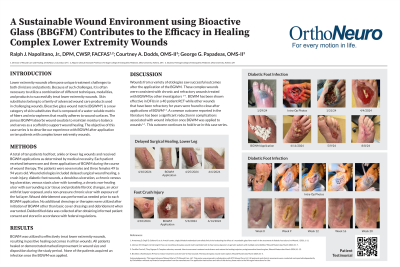
Results: BGWM was utilized to effectively treat lower extremity wounds, resulting in positive healing outcomes in all ten wounds. All patients healed or demonstrated marked improvement in wound size and disposition during the study period. None of the patients acquired an infection once the BGWM was applied.
Discussion: Wounds from a variety of etiologies saw successful outcomes after the application of the BGWM. These complex wounds were consistent with chronic and refractory wounds treated with BGWM by other investigators 1-4. BGWM has been shown effective in DFUs in a 40 patient RCT while other wounds that have been refractory for years were found to close after applications of BGWM1-4. A common outcome reported in the literature has been a significant reduction in complications associated with wound infection once BGWM was applied to wounds1-4.

.jpg)