(CS-075) Borate-Based Bioactive Glass Wound Matrix Overcomes Medication-Induced Healing Impairment in Polycythemia Vera
Friday, April 10, 2026
Introduction: Polycythemia vera (PV) is a myeloproliferative neoplasm requiring lifelong pharmacologic management, with hydroxyurea remaining a first-line cytoreductive therapy. However, 10–15% of patients develop hydroxyurea-associated cutaneous toxicity, including painful, non-healing ulcers that often resist conventional wound care.1,2 These ulcers are particularly challenging in older PV patients, who frequently have comorbidities requiring multiple concurrent medications that further impair tissue repair. The resulting polypharmacy creates a multifactorial healing barrier, combining hydroxyurea’s direct cytotoxic effects with systemic drug-induced suppression of inflammation, angiogenesis, and collagen synthesis. Hydroxyurea therapy for polycythemia vera can lead to severe cutaneous ulcers that often prove refractory to conventional treatments. We present a case where a borate-based glass fiber matrix (BBGFM) successfully overcame this barrier in three hydroxyurea cluster wounds on the right medial ankle in a 71-year-old male
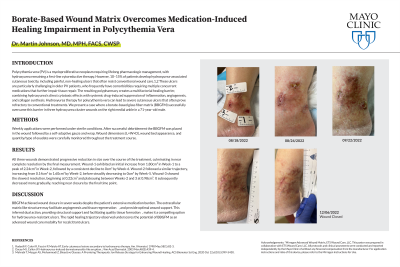
Methods: Weekly applications were performed under sterile conditions. After successful debridement the BBGFM was placed in the wound followed by a self-adaptive gauze and wrap. Wound dimensions (L×W×D), wound bed appearance, and quantity/type of exudate were carefully monitored throughout the treatment course.
Results: All three wounds demonstrated progressive reduction in size over the course of the treatment, culminating in near complete resolution by the final measurement. Wound-1 exhibited an initial increase from 1.80cm³ in Week-1 to a peak of 2.24cm³ in Week-2, followed by a consistent decline to 0cm³ by Week-6. Wound-2 followed a similar trajectory, increasing from 0.14cm³ to 1.60cm³ by Week-2, before steadily decreasing to 0cm³ by Week-5. Wound-3 showed the slowest resolution, beginning at 0.22cm³ and plateauing between Weeks-2 and 3 at 0.98cm³. It subsequently decreased more gradually, reaching near closure by the final time point.
Discussion: BBGFM achieved wound closure in seven weeks despite the patient’s extensive medication burden. The extracellular matrix like structure may facilitate angiogenesis and tissue regeneration , and provide optimal wound support. This inferred dual action, providing structural support and facilitating quality tissue formation , makes it a compelling option for hydroxyurea-resistant ulcers. The rapid healing trajectory observed underscores the potential of BBGFM as an advanced wound care modality for recalcitrant ulcers.

.jpg)