(CS-072) Case-Based Outcomes Using Borate-Based Bioactive Glass Fiber Matrix Skin Substitutes for Recalcitrant Wounds Following Trauma and Amputation
Friday, April 10, 2026
Mehreen Rahim, DPM – DPM, Swedish Hospital
Introduction: Chronic and post-surgical wounds, particularly in patients with comorbidities or a history of surgical complications, have the potential to stall, making healing difficult.1 Bioengineered skin substitutes have emerged as promising adjuncts in wound care.2,3 This case series describes the clinical course of three patients with complex lower extremity wounds treated using sequential applications of a Borate-Based Bioactive Glass Fiber Matrix (BBGFM) alongside standard wound care modalities
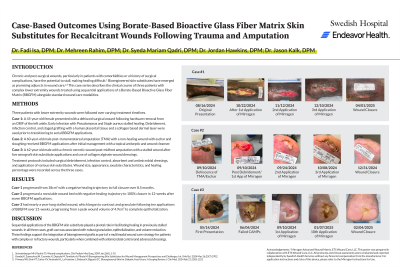
Methods: Three patients with lower extremity wounds were followed over varying treatment timelines. Case-1: A 45-year-old female presented with a dehisced surgical wound following hardware removal from an ORIF of the left ankle. Early infection with Pseudomonas and Staph aureus stalled healing. Debridement, infection control, and staged grafting with a human placental tissue and a collagen based dermal layer were used prior to transitioning to serial BBGFM applications. Case-2: A 60-year-old male post-transmetatarsal amputation (TMA) with a non-healing wound with eschar and sloughing received BBGFM applications after initial management with a topical antiseptic and wound cleanser. Case-3: A 62-year-old male with a chronic necrotic wound post-midfoot amputation with a stalled wound after five xenograft skin substitute applications and use of collagen alginate wound dressings. Treatment protocols included surgical debridement, infection control, absorbent and antimicrobial dressings, and application of various skin substitutes. Wound size, appearance, exudate characteristics, and healing percentage were recorded across the three cases
Results: Case-1 progressed from 18cm³ with a negative healing trajectory to full closure over 8.5 months. Case-2 progressed a nonviable wound bed with negative healing trajectory to 100% closure in 12-weeks after seven BBGFM applications. Case-3 had nearly a year-long stalled wound, which began to contract and granulate following ten applications of BBGFM over 21-weeks, progressing from a peak wound volume of 4.9cm³ to complete epithelialization
Discussion: Sequential applications of the BBGFM skin substitute played a pivotal role in facilitating healing in previously stalled wounds. In all three cases, graft use was associated with robust granulation, epithelialization, and volume reduction. These findings support the integration of bioengineered grafts as part of a multimodal wound care strategy for patients with complex or refractory wounds, particularly when combined with antimicrobial control and advanced dressings.

.jpg)