(CS-080) Use of Borate-Based Bioactive Glass Fiber Matrix for a Chronic Non-Healing Dorsal Foot Ulcer with Exposed Tendon and Hardware: A Case Report
Friday, April 10, 2026
Introduction: Chronic non-healing wounds, particularly those with exposed tendon or hardware, present a formidable clinical challenge. Surgical site dehiscence following joint fusion, especially in elderly patients, often results in prolonged wound care and risk of infection or hardware failure. Bioactive glass materials have shown promise in facilitating angiogenesis and tissue regeneration.1-3 We report a case of a 69-year-old female smoker with a chronic dorsal foot ulcer overlying a first metatarsophalangeal (MTP) joint fusion site that occurred after a fall, complicated by exposed tendon/hardware and removal, that demonstrated significant healing following application of borate-based bioactive glass fiber matrix (BBGFM)
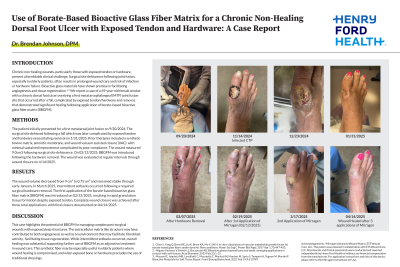
Methods: The patient initially presented for a first metatarsal joint fusion on 9/20/2024. The surgical site dehisced following a fall which was later complicated by exposed tendon and hardware necessitating removal on 1/31/2025. Prior therapies included a synthetic bovine matrix, amniotic membrane, and wound vacuum assisted closure (VAC), with minimal sustained improvement complicated by poor compliance. The wound measured 9.0cm3 following surgical site dehiscence. On 02/12/2025, BBGFM was introduced following the hardware removal. The wound was evaluated at regular intervals through wound closure on 4/14/2025
Results: The wound volume decreased from 9 cm³ to 0.75 cm³ and remained stable through early January. In March 2025, intermittent setbacks occurred following a required surgical hardware removal. The first application of the borate-based bioactive glass fiber matrix (BBGFM) was introduced on 02/12/2025, resulting in rapid granulation tissue formation despite exposed tendon. Complete wound closure was achieved after three total applications, with final closure documented on 04/14/2025
Discussion: This case highlights the potential of BBGFM in managing complex post-surgical wounds with exposed deep structures. The extracellular matrix like structure may have contributed to both angiogenesis as well as an environment that may facilitate fibroblast activity , facilitating tissue regeneration. While intermittent setbacks occurred, overall healing was substantial, supporting further use of BBGFM as an adjunctive treatment in wound care. This synthetic fiber may be especially useful in elderly patients where wound healing is compromised, and when exposed bone or hardware precludes the use of traditional dressings

.jpg)