
.jpg)
Laboratory Research
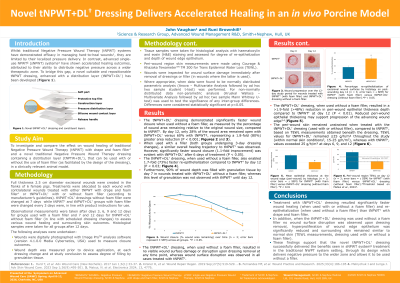
Whilst traditional Negative Pressure Wound Therapy (tNPWT) systems have demonstrated efficacy in managing hard-to-heal wounds¹, they are limited by their localized pressure delivery. In contrast, an advanced single-use NPWT† system has shown accelerated healing outcomes2, attributed to its ability to distribute negative pressure across a wider therapeutic zone. To bridge this gap, a novel tNPWT dressing, enhanced with a distribution layer (tNPWT+DL*) has been developed.
The work detailed here was carried out to investigate and compare the effect on wound healing of tNPWT (drape and foam filler)‡ and tNPWT+DL*, with and without the use of foam filler, in a clinically relevant animal model.
Methods:
A 12-day porcine wound healing in vivo study (n=3) was conducted comparing treatment with tNPWT‡ to treatment with tNPWT+DL* both with and without use of a foam filler. At dressing changes and at the end of the study wound progression was assessed by planimetry, wound depth was measured to assess degree of filling by granulation tissue, observation of surface disruption and readings of Trans-Epidermal Water Loss (TEWL) were taken. Following completion of the study live phase histological analysis of wound biopsies was undertaken to assess re-epithelialization and hyperproliferation of wound edge epithelium.
Differences were considered statistically significant at p< 0.05.
Results:
Treatment with tNPWT+DL* dressing (with or without a foam filler) resulted in significantly faster wound closure than tNPWT‡ (up to 80%). Furthermore, significantly faster re-epithelialization (73%) was also seen with tNPWT+DL* (without a filler).
In addition, when the WOUND+ dressing was used without a foam filler no wound surface disruption was observed upon dressing removal and hyperproliferation of wound edge epithelium was significantly reduced (48%). Additionally, when tNPWT+DL* was used skin surrounding the wound remained unstrained in terms of TEWL3 regardless of whether a foam filler was used, which was not the case when tNPWT‡ was used.
Discussion: These findings support that the novel tNPWT+DL* dressing successfully delivered the benefits seen in sNPWT system treatment in the traditional NWPT system setting, through its design which delivers negative pressure to the wider zone and allows it to be used without a filler.