(LR-004) Assessing the speed of antimicrobial activity within a nitric oxide-generating dressing against antibiotic-resistant wound pathogens
Friday, April 10, 2026
Emma Griffiths, PhD – Microbiology Manager, Convatec; Kate Meredith, PhD – Principal Scientist, Applied Research, Convatec; Daniel Metcalf, PhD – Director, Medical Science Liaison, Advanced Wound Care, Convatec
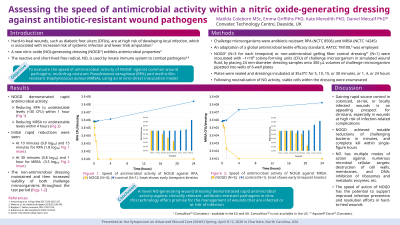
Introduction: Hard-to-heal wounds, such as diabetic foot ulcers, are at high risk of developing local infection. A multimodal nitric oxide-generating dressing (NOGD) has been designed to generate antimicrobial nitric oxide within the dressing. The aim of this study was to evaluate the speed of antimicrobial activity of NOGD against the common wound pathogens, multidrug-resistant Pseudomonas aeruginosa (RPA) and methicillin-resistant Staphylococcus aureus (MRSA), using an in vitro direct inoculation model.
Methods: An adapted version of the AATCC 100 antimicrobial susceptibility standard test method was used. Test dressings were inoculated with approximately 1×10⁶ colony-forming units (CFU) of challenge bacteria and then incubated at 35±3°C for 5, 10, 15 or 30 minutes, or 1, 4, or 24 hours. Viable counts were determined at these timepoints using dressing extracts after neutralization of nitric oxide activity. A non-antimicrobial dressing served as control throughout the test period.
Results: NOGD demonstrated rapid antimicrobial activity, reducing RPA to undetectable levels (< 30 CFU) within 1 hour, and reducing MRSA to undetectable levels within 4 hours. Initial rapid reductions were evident at just 10 minutes for RPA and 15 minutes for MRSA. The non-antimicrobial dressing maintained bacterial viability throughout the test period.
Discussion: NOGD was demonstrated to provide rapid and sustained antimicrobial activity against clinically relevant resistant pathogens, achieving notable reductions of challenging bacteria in minutes, and complete kill within hours. Gaining rapid source control in locally infected wounds is an appealing prospect for clinicians, especially in wounds at high risk of infection complications. The speed of action of NOGD has the potential to support improved infection prevention and resolution in hard-to-heal wounds.

.jpg)