(LR-023) The activity of a nitric oxide-generating dressing against surface-associated bacterial aggregates using a polycarbonate membrane colony model
Friday, April 10, 2026
Matilda Coleborn, MSc – Senior Scientist, Convatec; Emma Griffiths, PhD – Microbiology Manager, Convatec; Daniel Metcalf, PhD – Director, Medical Science Liaison, Advanced Wound Care, Convatec Ltd
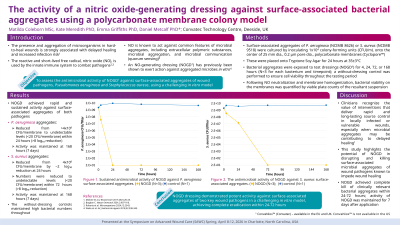
Introduction: The presence and aggregation of microorganisms in hard-to-heal wounds is strongly associated with delayed healing and increased infection risk. A nitric oxide-generating dressing (NOGD) has been designed to generate antimicrobial nitric oxide within the dressing. The aim of this study was to assess the antimicrobial activity of NOGD against surface-associated aggregates of known wound pathogens, Pseudomonas aeruginosa and Staphylococcus aureus, using a challenging in vitro model.
Methods: Surface-associated communities of P. aeruginosa or S. aureus were cultured by inoculating 1x10⁴ colony-forming units (CFU)/mL of bacteria onto the center of 25 mm diameter, 0.2 μm pore diameter, polycarbonate membranes (Cyclopore™). These were then placed onto Tryptone Soy Agar nutrient agar for 24 hours at 35±3°C. The resultant bacterial aggregates were exposed to NOGD for 4, 24, 72 or 168 hours (N=3 for each challenge microorganism and timepoint). Following nitric oxide neutralization and stomaching the membranes, bacterial viability on the membranes was quantified by viable plate counts of the resultant suspension. Untreated controls monitored bacterial viability throughout the tests.
Results: NOGD achieved rapid and sustained activity against surface-associated aggregates of both pathogens. P. aeruginosa surface-associated aggregates were reduced from >4x10⁹ CFU/membrane to undetectable levels (< 20 CFU/membrane) within 24 hours ( >8 log₁₀ reduction), which was maintained at 168 hours. S. aureus surface-associated aggregates were reduced from 4x10⁹ CFU/membrane by ~2 log₁₀ reduction at 24 hours and completely eradicated by 72 hours ( >8 log₁₀ reduction), which was maintained at 168 hours. Untreated controls confirmed bacterial viability throughout the tests.
Discussion: NOGD dressing demonstrated potent activity against surface-associated aggregates of two key wound pathogens in a challenging in vitro model, achieving complete eradication within 24-72 hours. This study highlights the potential of NOGD in disrupting surface-associated microbial aggregates that are known to impede healing of hard-to-heal wounds.

.jpg)