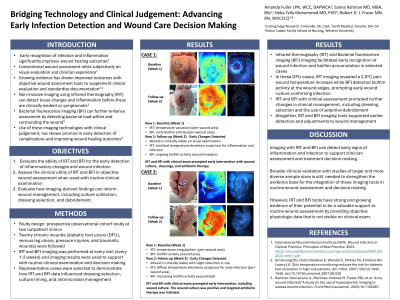
(CS-059) Bridging Technology and Clinical Judgment: Advancing Early Infection Detection and Wound Care Decision-Making
Friday, April 10, 2026
Robert Fraser, BSN, MN; Samia Rahman, MD, MBA – Swift Medical; Heba Tallah Mohammed, MD, PHD
Introduction: Early recognition of infection and inflammation have shown to significantly improve wound care outcomes. However, wound assessment today depends heavily on subjective measures and individual clinical experience. As expectations for objective documentation continue to grow, physiologic imaging offers a valuable tool for the clinician's exam. Spectral imaging allows us to see tissue changes beneath the surface, including changes in perfusion, hemoglobin distribution, and early inflammatory activity that are not easily visualized by our own eyes. Thermal imaging adds a second layer by identifying temperature differences within and around the wound that may indicate the start of infection. When utilized alongside our clinical judgement and experience, it gives us great insight for infection detection and improves quality outcomes.
Methods: The imaging system was implemented at two of our outpatient wound care programs, with providers trained in image capture. Twenty wounds, including diabetic foot, venous, pressure, and traumatic ulcers were followed every 1–2 weeks, with digital imaging at each visit to ensure consistent data collection. These findings were utilized together with the clinical exam, and representative cases were selected to demonstrate how spectral and thermal data informed dressing selection, culture timing, and antibiotic decisions.
Results: Spectral and thermal imaging improved our early recognition of wound infection and biofilm buildup within the selected cases. In a representative DFU case, thermal imaging revealed a 2.6°C periwound temperature increase that prompted an early wound culture confirming infection. Spectral imaging at the same visits showed an increase in biofilm activity at the wound edges, prompting us to change the type of dressing being utilized and the use of selective debridement. These two methods helped support earlier decision-making regarding changes in our treatment plan.
Discussion: Spectral and thermal imaging can enhance clinical evaluation and aid early infection detection while informing treatment decisions, making it an extremely valuable tool in modern wound assessment. Its overall evidence should be strengthened by more evaluation of larger and wider patient populations and wound types.

.jpg)