(EBP-009) Real-World Experience With Use Of Traditional Negative Pressure Wound Therapy Versus Single Use Systems – Retrospective Case Review In An Acute Wound Care Setting
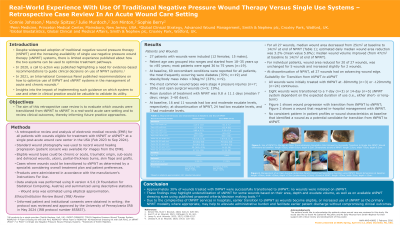
Introduction: Despite widespread use of traditional negative pressure wound therapy (tNPWT) and single use negative pressure wound therapy (sNPWT) to manage hard-to-heal wounds, how and when the two systems should be used in optimized treatment pathways is poorly understood.1 This retrospective study aimed to evaluate which wounds were transitioned from tNPWT to sNPWT in a real-world setting and whether a change in approach may be warranted to improve clinical outcomes and healthcare resources.
Methods: A retrospective case review of the treatment pathway and clinical outcomes for all patients with wounds eligible for NPWT (tNPWT or sNPWT*) presenting at a single acute care facility in the USA from February 2023 to September 2024. All wounds were treated with continuous NPWT administered at either -80 or -120mmHg.
Results: Electronic medical records for 27 patients with wounds eligible for NPWT were available for review. Mean duration of NPWT was 9.8±11.1 days (median 7 days; range: 3–60 days). Estimated daily mean wound area reduction was 5.8% (median value 3.2%) with improvements in median wound volume also observed. Of the 27 wounds treated with tNPWT, 8 were successfully transitioned to sNPWT. Review against clinical guidelines and published literature for use of tNPWT and sNPWT2,3 showed that at least 16 wounds were eligible for first line sNPWT use based on exudate levels, wound depth and wound area.
Discussion: Approximately 30% of wounds included in this retrospective review of real-world practice were successfully transitioned from tNPWT to sNPWT, facilitating earlier hospital discharge without compromising clinical outcomes. Despite more than half of wounds fulfilling the criteria for first line sNPWT therapy, no wounds were managed using this approach, suggesting potential underutilization in patients who may benefit from early adoption.

.jpg)