
.jpg)
Laboratory Research
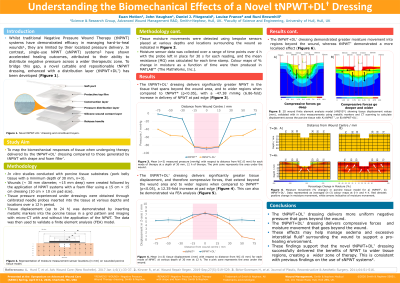
Whilst traditional Negative Pressure Wound Therapy (tNPWT) systems have demonstrated efficacy in managing hard-to-heal wounds¹, they are limited by their localized pressure delivery. In contrast, an advanced single-use NPWT† system has shown accelerated healing outcomes2, attributed to its ability to distribute negative pressure across a wider therapeutic zone. To bridge this gap, a novel tNPWT dressing, enhanced with a distribution layer (tNPWT+DL*) has been developed.
To map the biomechanical responses of tissue when undergoing therapy delivered by a novel traditional NPWT dressing, enhanced with a distribution layer (tNPWT+DL*) dressing compared to those generated by tNPWT with drape and foam filler (tNPWT‡).
Methods:
To demonstrate the biomechanical tissue effects of the tNPWT+DL* dressing, in vitro studies were conducted using open wound porcine models (n=3) over a period of up to 24 hours. Bespoke sensors were used to collect data at various depths and locations surrounding the wound pertaining to tissue moisture movement, pressures experienced by the tissue, and resultant tissue displacement patterns. Finite element analysis was used to verify and validate in vitro experimental data.
Results:
In vitro data showed that tNPWT+DL* delivers uniform negative pressure across the dressing, with a statistically significant (p >0.05) delta detected in pressure between locations surrounding the wound compared to tNPWT‡. The distribution of forces delivered by tNPWT+DL* caused identifiable tissue displacement in tissue surrounding the wound extending to wider regions than tNPWT‡, with statistically significant displacement (p< 0.05) observed. Time dependant studies showed that the tNPWT+DL* dressing influences the movement of moisture around the wound site and to the wider region under therapy to a greater degree than tNPWT‡.
Discussion:
The tNPWT+DL* dressing delivers NPWT, compressive forces and movements of moisture beyond the wound to the surrounding tissue and the wider zone, whereas tNPWT‡ was localised to the wound. The delivery of compressive therapy could be responsible for reducing oedema and the inflammatory environment, creating favourable wound healing conditions.