
.jpg)
Laboratory Research
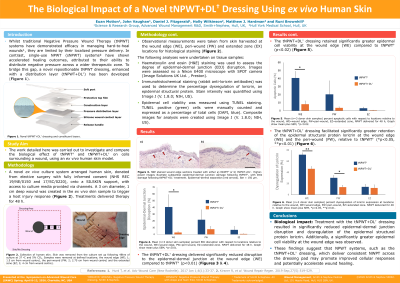
Whilst traditional Negative Pressure Wound Therapy (tNPWT) systems have demonstrated efficacy in managing hard-to-heal wounds1, they are limited by their localized pressure delivery. In contrast, an advanced single-use NPWT† system has shown accelerated healing outcomes2, attributed to its ability to distribute negative pressure across a wider therapeutic zone. To bridge this gap, a novel tNPWT dressing, enhanced with a distribution layer (tNPWT+DL*) has been developed.
The work detailed here was carried out to investigate the biological effect of tNPWT‡ and tNPWT+DL* on tissue, using a wounded ex vivo human skin model (NHS REC 19/NE/0150 and 17/SC/0220).
Methods:
Using wounded ex vivo human skin to demonstrate the biological effects of a tNPWT+DL* (n=3) and therapy applied for 48 hours. The skin was sampled at various locations at the wound edge (WE, 1.5 cm), peri-wound (PW, 2.75 cm) and a distance further from the wound (extended zone (EZ, 4 cm)). Histological analysis was undertaken using haematoxylin and eosin staining to assess epidermal-dermal junction disruption. Immunohistochemical staining was used to determine loricrin dysregulation and cell viability measured via TUNEL staining.
Results:
tNPWT+DL* dressing delivered significantly reduced epidermal-dermal junction disruption at the wound edge (WE) compared to tNPWT‡ (p< 0.01). Treatment with tNPWT+DL* dressing maintained significantly greater epidermal cell viability at the wound edge (WE) compared to tNPWT‡ (p< 0.02). The tNPWT+DL* dressing facilitated significantly greater retention of the epidermal structural protein loricrin at the WE (p< 0.05) and the PW (p< 0.01), compared to tNPWT‡.
Discussion:
Treatment with the tNPWT+DL* dressing resulted in significantly reduced epidermal-dermal junction disruption and dysregulation of the epidermal structural protein loricrin. Additionally, more viable cells were detected at the wound edge. These findings suggest that NPWT systems, such as the tNPWT+DL* dressing, which delivers consistent NWPT across the dressing pad may promote an environment conducive to wound healing.