
.jpg)
Case Series/Study
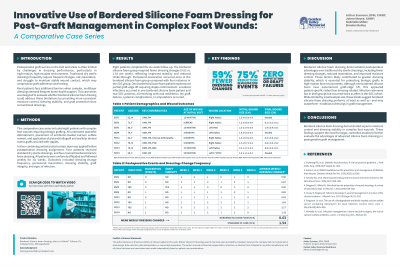
Results: Eight patients completed the six-week follow-up. The bordered silicone foam dressing group required fewer dressing changes (0.63 vs. 1.54 per week), reflecting improved stability and reduced strike-through. Periwound maceration occurred once in the bordred foam silicone dressing group compared with four instances in the SOC group. One bordered silicone foam patient experienced partial graft-edge lift requiring staple reinforcement. Localized infections occurred in one bordered silicone foam dressing patient and two SOC patients, all resolving with oral antibiotics. No graft failures, systemic complications, or amputations occurred. Overall, bordred foam silicone dressings demonstrated favorable trends in moisture control and dressing performance.
Discussion: Bordered silicone foam dressings demonstrated postoperative advantages over traditional dry sterile dressings, including fewer dressing changes, reduced maceration, and improved moisture control. These factors likely contributed to greater dressing stability, which is essential for protecting biologic grafts in high-motion foot environments. Although one bordered silicone foam dressing case experienced graft-edge lift, this appeared patient-specific rather than dressing-related. Infection rates were low in both groups but occurred twice as often in the SOC cohort. While limited by small sample size, these trends suggest bordered silicone foam dressings perform at least as well as, and may outperform, traditional dressings in graft management.