
.jpg)
Laboratory Research
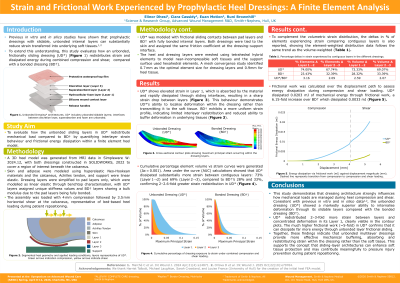
Previous in vitro and in silico studies have demonstrated that prophylactic dressings with able to slide pad layers can reduce strain in underlying soft tissue.1,2 To better understand this, this work evaluates how a prophylactic dressing, with unbonded, slidable layers redistributes strain and dissipates energy through frictional sliding compared to a bonded dressing, can contribute to the protection of soft tissue.
Methods:
A finite element analysis (FEA) using an anatomically representative heel model assessed strain within dressing layers under compression and shear loading. The dressing architectures were modelled with compressive elasticity moduli, Poisson’s ratio and where appropriate coefficients of friction. Comparisons were made between unbonded (slidable) and bonded multilayer dressings.
Results:
The unbonded dressing exhibited greater reduction in strain between contiguous layers, effectively redistributing mechanical energy through layer-to-layer movement with frictional sliding. Strain between layer 1 (skin side) and layer 2 decreased by 74% in the unbonded dressing versus 23% in the bonded version, a threefold difference. Between layers 2 and 3 (support side), reductions were 68% versus 32%. Energy dissipation through frictional work was 83.9% greater in the unbonded dressing, demonstrating superior capacity to mitigate shear forces and enhance tissue protection.
Discussion:
FEA indicates that unbonded, slidable pad layers absorb and redistribute strain energy before reaching tissue, substantially reducing soft tissue strain under combined loading. These findings highlight the potential benefit of prophylactic use unbonded multilayer dressings as part of a pressure injury prevention protocol.