
.jpg)
Laboratory Research
Pressure ulcers pose significant healthcare challenges, causing morbidity, prolonged hospitalisation, and high costs. Prophylactic dressings can mitigate mechanical forces at vulnerable sites, but performance depends on material properties and interlayer mechanics.
These studies compared an unbonded multilayer dressing (UD*), a bonded dressing (BD†), and a single-layer hydrogel dressing (HD‡) regarding mechanical force dissipation.
Methods:
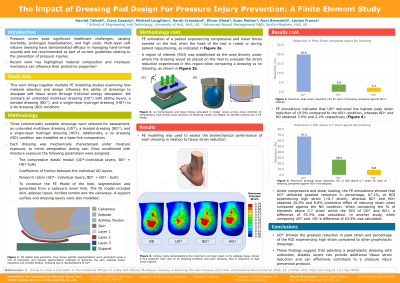
This work brings together multiple finite element modelling studies. The following parameters were assigned to the relevant materials or dressings: compressive elastic moduli, Poisson’s ratio, and interlayer friction where appropriate. UD* layers: mask, superabsorbent polymer (SAP), and foam were assessed individually; BD† and HD‡ were tested in bulk. Data informed a finite element (FE) heel model incorporating skin, adipose, and bone under compression and shear.
Results:
FE simulations showed UD* reduced peak adipose strain by 19.9% versus undressed heel, 3.9% for BD†, and 2.2% for HD‡. In high-strain regions ( >0.7), UD* achieved reductions of 67.1% versus no dressing, BD† achieved 26.5%, and HD‡ achieved 8.8%. Interlayer sliding in UD* dissipated shear more effectively than bonded or single-layer designs, promoting strain dissipation.
Discussion:
Layer-specific mechanics and interfacial dynamics influence dressing efficacy. UD*’s unbonded architecture provided superior strain reduction compared to bonded and single-layer dressings. This experimental–computational approach offers a framework for optimising next-generation prophylactic dressings.