(HE-004 (RPT-007)) Early outcomes of implementing a new multilayer foam dressing in an acute setting: assessing clinical and financial impact through value-based procurement
Saturday, April 11, 2026
5:15 PM - 5:40 PM ET
Joanne Wilkins, RN, MSc – Convatec Technology Centre, Deeside, United Kingdom; James Fisher, BSc – Convatec Technology Centre, Deeside, United Kingdom; Rebecca Rodger, BSc – Convatec Technology Centre, Deeside, United Kingdom
Introduction: The rising burden of chronic wounds and increasing product costs make cost-effective procurement essential.1 Traditional models that prioritise lowest upfront price risk higher long-term costs and poorer outcomes by neglecting healing time, resource use, and nurse workload.2 Value-based procurement (VBP), aligned with value-based healthcare, shifts focus from price to overall value-health outcomes achieved relative to costs.3 In wound care, advanced dressings can reduce dressing changes, resource use, and healing time. Europe’s MEAT framework reflects this by integrating cost-effectiveness, innovation, and sustainability in procurement decisions.4 The aim of this study was to demonstrate the clinical and economic impact of introducing a multilayer foam dressing* within a VBP framework, focusing on improving wear time through effective exudate management, enhanced adhesive performance, and reduced need for dressing layering.
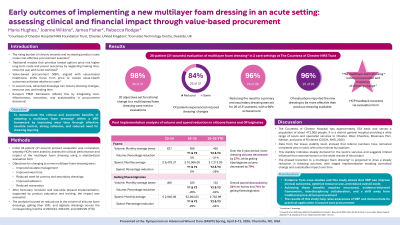
Methods: 28 patients (31 wounds) were evaluated across two care settings at the Countess of Chester NHS Trust over a 3-year period using a standardised assessment form. Objectives for changing to the foam dressing were: improved exudate control, extended wear time, reduced need for primary and secondary dressings, enhanced adhesion, and decreased maceration. Following formulary inclusion, a phased site-wide implementation supported by education and training was completed. Post-implementation analysis compared monthly volumes and spend for silicone foams, gelling fibres, and alginates across the respective months of 2023/24, 2024/25 and 2025/26 (year-to-date).
Results: Clinical objectives were met in 98% of cases (30/31). Dressing changes were reduced in 84% of wounds (26/31), and 96% achieved reduced need for additional dressings (25/26). All evaluations (100%) rated the new dressing more effective than previous options. Post-implementation analysis showed a 27% reduction in foam volumes and 70% in gelling fibre/alginate volumes over three years. Corresponding spend decreased by 24% for foams and 74% for gelling fibres/alginate dressings.
Discussion: Introducing a multilayer foam dressing* within a VBP framework improved clinical outcomes and optimised resource utilization, reducing dressing changes and overall expenditure. These findings support structured, evidence-informed procurement strategies that prioritise value over lowest upfront cost and drives sustainable improvements in wound care.

.jpg)