
.jpg)
Clinical Research
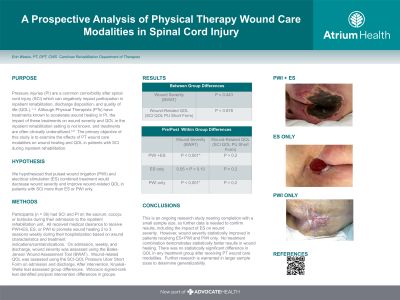
Pressure injuries (PI) are a common comorbidity after spinal cord injury (SCI) which can negatively impact participation in inpatient rehabilitation, discharge disposition, and quality of life (QOL).1–4 Although Physical Therapists (PTs) have treatments known to accelerate wound healing in PI, the impact of these treatments on wound severity and QOL in the inpatient rehabilitation setting is not known, and treatments are often clinically underutilized.4,5 The primary objective of this study is to examine the effects of PT wound care modalities on wound healing and QOL in patients with SCI during inpatient rehabilitation. We hypothesized that pulsed wound irrigation (PWI) and electrical stimulation (ES) combined treatment would decrease wound severity and improve wound care QOL in patients with SCI more than ES or PWI only.
Methods:
Participants had SCI and PI on the sacrum, coccyx, or buttocks during their admission to the inpatient rehabilitation unit. All received medical clearance to receive PWI+ES, ES, or PWI to promote wound healing 2 to 3 sessions weekly during their hospitalization based on wound characteristics and treatment indications/contraindications. On admission, weekly, and discharge, wound severity was assessed using the Bates-Jenson Wound Assessment Tool (BWAT). Wound-related QOL was assessed using the SCI-QOL Pressure Injury Short Form on admission and discharge. After intervention, Kruskal-Wallis test assessed group differences. Wilcoxon signed-rank test identified pre/post intervention differences in groups.
Results:
Participants were enrolled between October 11, 2022 and May 23, 2025. No statistically significant difference was found between groups for wound severity or QOL scores. Pre/post intervention improvements wound severity was statistically significant in the PWI+ES group and PWI group (P < 0.001), with the ES group approaching clinical significance (0.05 < P < 0.10).
Discussion: This is an ongoing research study nearing completion with a small sample size, so further data is needed to confirm results, including the impact of ES on wound severity. However, wound severity statistically improved in patients receiving ES+PWI and PWI only. No treatment combination demonstrates statistically better results in wound healing. There was no statistically significant difference in QOL in any treatment group after receiving PT wound care modalities. Further research is warranted in larger sample sizes to determine generalizability.