Introduction: Chronic venous stasis ulcers (CVSUs) and pyoderma gangrenosum (PG) are debilitating skin conditions characterized by chronic inflammation, tissue breakdown, and impaired healing. CVSUs result from venous insufficiency and sustained venous hypertension, while PG is an autoinflammatory neutrophilic dermatosis often associated with systemic disease. Both conditions are frequently refractory to conventional treatments, leading to prolonged discomfort and increased healthcare burden.1-2 Mirragen Advanced Wound Matrix is a completely bioabsorbable borate-based glass fiber matrix designed to support tissue regeneration by facilitating angiogenesis, collagen deposition, and re-epithelialization. FDA-cleared for various acute and chronic wounds, Mirragen presents a novel option for enhancing healing in difficult cases. This prospective case series describes our clinical experience using Mirragen as an adjunctive treatment in patients with non-healing CVSUs, with and without associated PG.
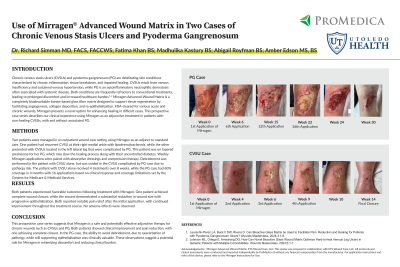
Methods: Two patients were managed in an outpatient wound care setting using Mirragen as an adjunct to standard care. One patient had recurrent CVSU at their right medial ankle with lipodermatosclerosis, while the other presented with CVSUs located in the left lateral leg that were complicated by PG. This patient was on tapered prednisone for her PG, which may slow the healing process along with their uncontrolled diabetes. Weekly Mirragen applications were paired with absorptive dressings and compression therapy. Debridement was performed in the patient with CVSU alone, but was voided in the CVSU complicated by PG case due to pathergy risk. The patient with CVSU alone received 4 treatments over 8 weeks, while the PG case had 60% coverage in 4 months with 16 applications based on clinical response and coverage limitations set by the Centers for Medicare & Medicaid Services.
Results: Both patients experienced favorable outcomes following treatment with Mirragen. One patient achieved complete wound closure, while the second demonstrated a substantial reduction in wound size with progressive epithelialization. Both reported notable pain relief after the initial application, with continued improvement throughout the treatment course. No adverse effects were observed.
Discussion: This prospective case series suggests that Mirragen is a safe and potentially effective adjunctive therapy for chronic wounds such as CVSUs and PG. Both patients showed clinical improvement and pain reduction, with one achieving complete closure. In the PG case, the ability to avoid debridement, due to exacerbation of pathergy, while still supporting epithelialization was clinically valuable. These observations suggest a potential role for Mirragen in minimizing discomfort and reducing clinical burden.

.jpg)