(CS-159) Advancing Secondary Intention Healing in Complex Post-Mohs Defects with a Bioactive Glass Fiber Matrix (BBGFM)
Friday, April 10, 2026
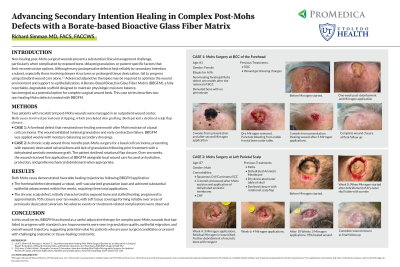
Introduction: Non-healing post-Mohs surgical wounds present a substantial clinical management challenge, particularly when complicated by exposed bone, delayed granulation, or patient-specific factors that limit reconstructive options. Although many postoperative defects heal reliably by secondary intention, a subset, especially those involving deeper structures or prolonged tissue desiccation, fail to progress using standard wound care alone.1,2 Advanced adjunctive therapies may be required to optimize the wound environment and support re-epithelialization. A Borate-Based Bioactive Glass Fiber Matrix (BBGFM), a fully resorbable, degradable scaffold designed to maintain physiologic moisture balance, has emerged as a potential option for complex surgical wound beds. This case series describes two non-healing Mohs defects treated with BBGFM.
Methods: Two patients with recalcitrant post-Mohs wounds were managed in an outpatient wound center. • Case 1: A forehead defect that remained non-healing one month after Mohs excision of a basal cell carcinoma. The wound exhibited minimal granulation and early contraction failure. BBGFM was applied weekly with moisture-balancing secondary dressings. • Case 2: A chronic scalp wound three months post-Mohs surgery for a basal cell carcinoma, presenting with exposed, desiccated calvarial bone and lack of granulation following prior treatment with a dehydrated amniotic membrane graft. The patient declined rotational flap closure. Over ten weeks, the wound received five applications of BBGFM alongside local wound care focused on hydration, protection, and gentle mechanical debridement when appropriate.
Results: Both Mohs cases demonstrated favorable healing trajectories following BBGFM application. • The forehead defect developed a robust, well-vascularized granulation base and achieved substantial epithelial advancement within five weeks, requiring three total applications. • The chronic scalp defect, initially characterized by exposed bone and stalled healing, progressed to approximately 95% closure over ten weeks, with soft tissue coverage forming reliably over areas of previously desiccated calvarium. No adverse events or treatment-related complications were observed.
Discussion: In this small series, BBGFM functioned as a useful adjunctive therapy for complex post-Mohs wounds that had failed to progress with standard care. Improvements were seen in granulation quality, epithelial migration, and overall wound trajectory, suggesting potential value for patients who are poor surgical candidates or present with challenging anatomic or tissue-healing constraints.

.jpg)