
.jpg)
Clinical Research
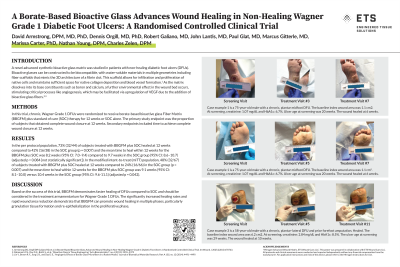
A novel advanced synthetic bioactive glass matrix was studied in patients with non-healing diabetic foot ulcers (DFUs). Bioactive glasses can be constructed to be biocompatible, with water-soluble materials in multiple geometries including fiber scaffolds that mimic the 3D architecture of a fibrin clot. This scaffold allows for infiltration and proliferation of native cells and maintains sufficient space for native collagen deposition and blood vessel formation.1 As the matrix dissolves into its base constituents such as boron and calcium, a further environmental effect in the wound bed occurs, stimulating critical processes like angiogenesis, which may be facilitated via upregulation of VEGF due to the addition of bioactive glass fibers.2,3
Methods:
In this trial, chronic, Wagner Grade 1 DFUs were randomized to receive borate-based bioactive glass Fiber Matrix (BBGFM) plus standard of care (SOC) therapy for 12 weeks or SOC alone. The primary study endpoint was the proportion of subjects that obtained complete wound closure at 12 weeks. Secondary endpoints included time to achieve complete wound closure at 12 weeks.
Results:
In the per protocol population, 73% (32/44) of subjects treated with BBGFM plus SOC healed at 12 weeks compared to 42% (16/38) in the SOC group (p = 0.007) and the mean time to heal within 12 weeks for the BBGFM plus SOC was 8.2 weeks (95% CI: 7.0–9.4) compared to 9.7 weeks in the SOC group (95% CI: 8.6–10.7) (adjusted p = 0.084 [not statistically significant]). In the modified intent‐to‐treat (mITT) population, 48% (32/67) of subjects treated with BBGFM plus SOC healed at 12 weeks compared to 24% (16/66) in the SOC group (p = 0.007) and the mean time to heal within 12 weeks for the BBGFM plus SOC group was 9.1 weeks (95% CI: 8.1–10.0) versus 10.4 weeks in the SOC group (95% CI: 9.6‐11.1) (adjusted p = 0.042).
Discussion:
Based on the success of this trial, BBGFM demonstrates faster healing of DFUs compared to SOC and should be considered in the treatment armamentarium for Wagner Grade 1 DFUs. The significantly increased healing rates and rapid wound area reduction demonstrate that BBGFM can promote wound healing in multiple phases, particularly granulation tissue formation and re‐epithelialization in the proliferative phase.