
.jpg)
Case Series/Study
Chronic wounds such as venous leg ulcers (VLUs) and diabetic foot ulcers (DFUs) pose substantial clinical challenges, especially among medically fragile and mobility-limited patients. These wound types are often recalcitrant to standard care, prompting increased use of advanced wound therapies to stimulate healing. Effective wound bed preparation, including debridement of nonviable tissue, control of bioburden and exudate, and optimization of the local microenvironment, is essential to support granulation and re-epithelialization.1,2
Methods:
Wound progression was monitored through serial measurements and photographic documentation. The BBGFM was applied following clinical recommendation until closure or evidence of meaningful progression was observed.
Results:
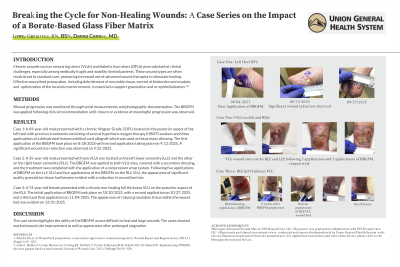
Case 1: A 69-year-old male presented with a chronic Wagner Grade 3 DFU located on the posterior aspect of the left heel with previous treatments consisting of several hyperbaric oxygen therapy (HBOT) sessions and three applications of a dehydrated human umbilical cord allograft which was used as the primary dressing. The first application of the BBGFM took place on 8/28/2025 with second application taking place on 9/12/2025. A significant wound size reduction was observed on 9/25/2025.
Case 2: A 35-year-old male presented with two VLUs one located on the left lower extremity (LLE) and the other on the right lower extremity (RLE). The BBGFM was applied to both VLU sites, covered with a secondary dressing, and the treatment was completed with the application of a compression wrap system. Following five applications of BBGFM on the LLE VLU and four applications of the BBGFM on the RLE VLU, the appearance of significant quality granulation tissue had become evident with a reduction in wound bed size.
Case 3: A 74-year-old female presented with a chronic non-healing full thickness VLU on the posterior aspect of the RLE. The initial application of BBGFM took place on 10/20/2025, with a second application on 10/27/2025, and a third and final application on 11/04/2025. The appearance of robust granulation tissue within the wound bed was evident on 12/01/2025.
Discussion:
The case series highlights the utility of the BBGFM across difficult to heal and large wounds. The cases showed marked wound size improvement as well as appearance after prolonged stagnation.