
.jpg)
Laboratory Research
Medical adhesives are designed to keep dressings and medical devices securely in place, but their strong adhesion often leads to medical adhesive-related skin injury (MARSI), especially when aggressive adhesives are involved, or when dressings are left on for several days or are frequently removed.1-3 The risk of MARSI can range widely, from 16% to 77%, and can add significant costs—up to $88.50 per case.3-6 To address this, clinicians may use skin barriers or adhesive removers, though these interventions increase both cost and time.
A light-switchable adhesive film dressing (LSFD) provides strong adhesion but releases gently with near-UV light exposure on human skin.7-9 However, in certain instances, clinicians must use adhesives supplied with the devices, such as ostomy baseplates or dressing kits for NPWT devices.3,6 This study examines whether LSFDs can serve as a barrier between aggressive adhesives and skin, enabling gentle removal when exposed to near-UV light.
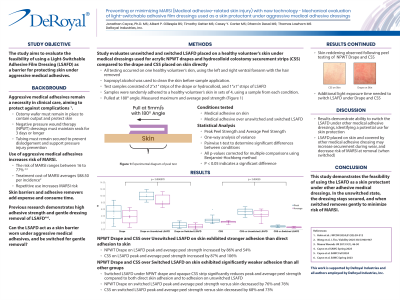
Methods: The research involved applying LSFD samples to the ventral forearm of a healthy volunteer. Over these and on skin, either colostomy securement strips (CSS) with hydrocolloid adhesive or NPWT drapes were applied. After an hour, the dressings were removed—those over LSFDs were switched with near-UV light before removal. In paired tests, peel strength was measured by pulling at 180O at 5 mm/s. Redness was noted immediately following removal. Statistical analysis was performed to compare the strength required for removal across conditions, with significance set at p < 0.05 and adjustments for multiple comparisons.
Results:
CSS on skin showed a mean maximum peel strength of 2.39 ± 0.25 N, and mean average peel strength of 2.14 ± 0.21 N. NPWT drape on skin showed mean maximum peel strength of 4.36 ± 1.93 N and mean average of 3.07 ± 1.31 N. Switched LSFD under CSS reduced mean maximum peel strength to 0.88 ± 0.22 N (p = 0.0044) and average to 0.58 ± 0.17 N (p = 0.0002). Under NPWT drape, switched LSFD reduced mean maximum peel strength to 0.85 ± 0.48 N (p = 0.0052) and average to 0.54 ± 0.32 N (p = 0.0003). Mild redness was observed for samples placed directly on skin.
Discussion: This study demonstrates the potential for LSFDs to serve as a skin protectant under other dressings and medical adhesives in clinical practice, potentially minimizing the risk of MARSI and reducing patient pain, which may lead to improved outcomes