
.jpg)
Clinical Research
Tunneling and undermining in chronic wounds are often associated with persistent inflammation, increased susceptibility to infection, and delayed healing. 1-3 These features often serve as nidus for chronicity and recalcitrance. Although surgical excision is effective; it is frequently impracticable due to the recurrent nature of these features. Porcine-derived urinary bladder matrix (UBM) products provide a biologically favorable environment that supports a pro-remodeling immune response, aiding the closure of complex wounds such as diabetic foot ulcers, venous leg ulcers, and pressure ulcers.1-3
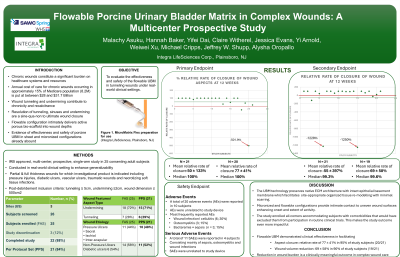
The flowable UBM particulate system is specially designed for precise delivery of product into wound tunnels, recesses, crevices, and cavities. This multicenter, prospective study evaluated the safety and effectiveness of flowable UBM in managing tunneling and undermining wound features as well as the impact on closure of the overlying wound concurrently treated with the particulate and sheet configurations of the porcine urinary bladder matrix.
Methods:
Following IRB approval and informed consent, enrolled subjects received flowable UBM treatment of their wound aspects (undermining and tunneling) and a combination of the particulate and sheet configuration of UBM to the overlying wound. The primary endpoint is the relative percentage reduction in tunneling volume or undermining depth at 12 weeks while secondary endpoint is the relative reduction in the dimensions of the overlying wound and proportion of wounds that closed through the 12-week study period. Safety endpoint was assessed by device-related adverse events and serious adverse events.
Results:
Of the 25 enrolled subjects, 21 met per-protocol criteria. Among these, 15 (71%) had wounds exhibiting undermining and 6 (29%) had tunneling. At 12 weeks, complete resolution was achieved in 11 wound aspects (52.4%), including 8 of 15 (53%) undermining aspects and 3 of 6 (50%) tunneling aspects. By wound etiology, complete resolution occurred in 9 of 11 (81%) non–pressure ulcer wounds and 2 of 10 (20%) pressure ulcer wounds. The mean percentage reduction in tunneling or undermining dimensions was 50 ± 133% (median: 100%). No device-related adverse events were reported.
Discussion: This study demonstrated the effectiveness of flowable UBM particulate in facilitating the resolution of tunneling and undermining features in complex wounds, and in supporting reduction in overall wound dimensions as well as effecting closure in a proportion of these difficult-to-heal wounds.