(CR-065) Evaluating the dispersion and residuum of a novel pure hypochlorous acid preserved antimicrobial wound gel on intact skin
Friday, April 10, 2026
Introduction: TThis pilot study investigates the absorptive properties and qualities of a novel antimicrobial gel on intact human skin. Current topical wound care treatments often leave a residue or require prolonged drying times, which can negatively impact patient comfort, aesthetic perception, use, and adherence. This study aimed to assess the dispersion & product residuum on intact skin of a new skin & wound antimicrobial gel, hypothesizing that its unique formulation with limited ingredients allows for swift dermal dispersion without leaving a sticky or visible cast or macerating the skin. A key objective is to provide preliminary data supporting its potential use in a broader range of clinical applications where rapid clinical effect and subsequent dispersion is beneficial such as incontinence associated dermatitis, intertrigo, and in other clinical environments.
Methods: A single-center, small-cohort study was conducted on healthy adult volunteers. The antimicrobial hydrogel was appliedto a standardized 2x2 cm area on the volar forearm. The post-application dispersion process was analyzed utilizing the Mimosa Pro™ digital imaging system to ensure consistency and high-quality data including of the contralateral limb volar surface. Multi-spectral tissue interrogation collected tissue oximetry, temperature, and a digital image followed by assessment via handheld low power point of care microscopy. Image collection captured baseline images of the skin, sequential images were then taken at 5 minute intervals to visually assess the rate of dispersion and the presence of any residuum. A quantitative score was later assigned by a blinded specialist based on the visual evidence. Additionally, a subjective Likert patient questionnaire was administered to gauge the sensation of stickiness and overall comfort.
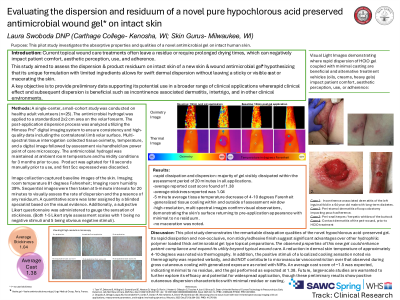
Results: The antimicrobial gel demonstrates rapid dissipation and dispersion in participants. The majority of the gel was visibly dissipated within the assessment period in all subjects. An average cast score of 0.5-1.5 was expected, indicating minimal to no residue. The high-resolution, multi spectral images confirm visual observations, demonstrating the skin's surface returning to pre-application appearance with minimal residuum.
Discussion: This pilot study demonstrates the remarkable dissipation qualities of the novel hypochlorous acid-preserved gel. Its rapid dissipation and non-occlusive, non sticky/adhesive finish suggest significant advantages over other hydrophilic polymer loaded thick antimicrobial gel type topical preparations. The observed properties on this new gel could enhance patient compliance and expand its utility beyond typical wound care. Future, larger-scale studies are warranted to further explore its efficacy and potential for widespread application.

.jpg)