
.jpg)
Clinical Research
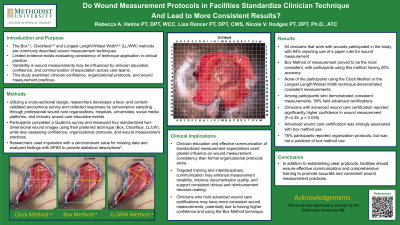
The box1,2, clockface3,4, and longest length/widest width3,4 methods are commonly described wound measurement techniques; however, limited evidence exists evaluating consistency of technique application in clinical practice. Variability in wound measurements may be influenced by clinician education, confidence, and communication of expectations across care teams. This study examined clinician confidence, organizational protocols, and wound measurement practices.
Methods: Using a cross-sectional design, researchers developed a face- and content-validated anonymous survey and collected responses over six months using convenience sampling. Recruitment occurred through professional wound care organizations, hospitals, universities, social media platforms, and industry wound care education events. Participants completed a Qualtrics survey assessing confidence, organizational protocol, and wound measurement strategy. Participants measured four standardized two-dimensional wound images using their preferred technique (box, longest length/widest width, or clockface). Missing data were addressed using zero/constant value imputation. Data were analyzed using Microsoft Excel and Jamovi5. ANOVA evaluated differences in confidence among clinicians with advanced wound care certification. Pearson correlation assessed relationships between advanced certification, confidence, and knowledge of reimbursement impact. Facility protocol use was analyzed using odds ratios, and associations between certification and technique use were examined using chi-square analysis.
Results:
Ninety-four clinicians participated; 94% reported using a paper ruler for wound measurement. Consistent measurement across all four wounds was demonstrated by 20% (19/94) of participants using the box method, whereas no participants using longest length/widest width or clockface methods demonstrated consistency. Clinician confidence was high overall, with 34% reporting extreme confidence, 55% very confident, and 10% somewhat confident. Clinicians with advanced wound care certification reported significantly higher confidence (F=4.39, p=.039). Among participants demonstrating consistent measurement, 58% held advanced certification. While 76% reported the presence of organizational measurement protocols, facility protocol was not a significant predictor of box method use (OR=.78, p=.55). In contrast, advanced wound care certification was strongly associated with box method use (χ²(2)=23.14, p< .001, φ=0.49).
Discussion:
These findings suggest that clinician education and effective communication of standardized measurement expectations exert greater influence on wound measurement consistency than formal organizational protocols alone. Targeted training and interdisciplinary communication may enhance measurement reliability, improve documentation quality, and support consistent clinical and reimbursement decision-making.