
.jpg)
Clinical Research
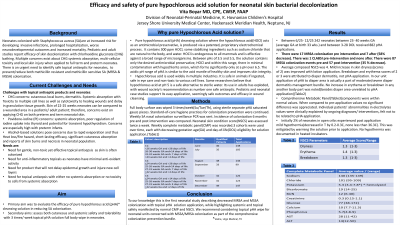
Neonates colonized with Staphylococcus aureus (SA)are at increased risk for developing invasive infections, worse neurodevelopmental outcomes, prolong hospitalization and increased mortality. Pediatric and adult studies report efficacy of skin decolonization with chlorhexidine gluconate (CHG) bathing. Multiple concerns exist about CHG systemic absorption, multi-cellular toxicity and local skin injury when applied to preterm neonates. There is an urgent need to identify safe topical antiseptic for neonates, to prevent/reduce both methicillin resistant and methicillin sensitive SA (MRSA & MSSA) colonization. Primary aim was to evaluate the efficacy of pure hypochlorous acid (pHA) cleansing solution in reducing SA colonization. Secondary aims: assess both cutaneous and systemic safety and tolerability with 3 times/ week topical pHA solution full body wipe in neonates.
Methods:
Full body surface was wiped 3 times/week(Su/Tue/Th), using sterile separate pHA saturated gauze pieces. Standard-of-care hygiene practices were continued. Weekly SA nasal colonization surveillance PCR was sent. Incidence of colonization 6 months pre and post intervention was compared. Neonatal skin condition score(NSCS) was assessed twice a week. Weekly complete metabolic panel(CMP) was recorded.3 cohorts were used over time, each with decreasing gestation age(GA) and day-of-life(DOL) eligibility for solution application.(Table1)
Results:
Between 6/25- 12/25 242 neonates between 23- 40 weeks GA (average GA at birth 33 wks.) and between 3-28 DOL received 726 pHA applications.
There were 17 Methicillin Resistant SA colonization pre intervention and 7 after (58% decrease). There was 1 CLABSI pre-intervention and none after. There were 87 Methicillin Sensitive SA colonization events pre and 57 post intervention (35 % decrease).
Average NSCS was 3.4. Mild increase in skin dryness was improved with lotion application.(Table2) CMP (Table 2)components were within normal values. When compared to pre-application values no significant difference was appreciated. Individual patients’ abnormalities in electrolytes values were clinically explained by ongoing diagnoses/ interventions, felt not to be related to pHA application.
Initially 2% of neonates in open cribs experienced post application mild hypothermia(decreased in T by 0.2-0.3C, none less than 36.3C). This was mitigated by warming the solution prior to application. No hypothermia was documented in heated incubators.
Discussion:
To our knowledge this is the first neonatal study describing decreased MRSA and MSSA colonization with topical pHA solution application, while highlighting systemic and topical safety manifested by normal CMP and NSCS.