(CS-172) From Cancer to Closure: Exploring Ultrasound in Post-Surgical Repair
Friday, April 10, 2026
Katherine Glaser, MD – Dermatology; John Holtzman, DPM – Podiatry
Introduction: When dealing with chronic wound healing in patients with different comorbidities and/or the geriatric population, there is a concern for an increased risk of infection, delayed closure, and functional limitations. Evidence suggests that non-contact low-frequency utlrasound therapy* may enhance healing by stimulating cellular activity, reducing bioburden, and promoting granulation tissue formation. This case describes the use of this modality to support healing ina large post-excisional wound in an older adult.
Methods: An older adult female with a medical history significant for chronic comorbid conditions presented with a nonhealing ulcer of the lower leg that was subsequently diagnosed as squamous cell carcinoma. Surgical excision resulted in a sizable soft tisuue defect measuring 4.5x5.0x0.3cm on her anterior distal leg. To help assist in proper healing, non-contact low-frequency ultrasound therapy* was initiated as an adjunct to standard wound care. Treatments were provided which included a 7-week period of ultrasound therapy use. Wound progression was assessed clinically at routine visits, evaluating changes in size, granulation formation, epithelialization, and overall tolerance to therapy.
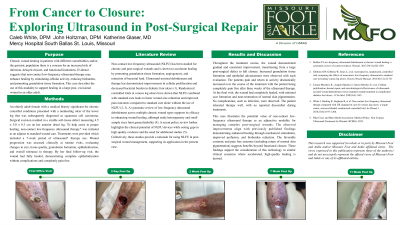
Results: Throughout the treatment course, the wound demonstrated gradual and consistent improvement, transitioning from a large post-surgical defect to a full closure. Increased granulation tissue formation and epithelial advancement were observed with each evaluation. The patient's pain and return to activity dramatically increased over the course of the treatment with the patient being pain free after three weeks of the ultrasound therapy. At the final visit, the wound had completely healed, with minimal scar formation and near-restoration of normal skin pigmentation. No complications, such as infection, were observed. The patient tolerated therapy well, with no reported discomfort during treatments.
Discussion: This case illustrates the potential value of non-contact low-frequency ultrasound therapy* as an adjunctive modality for managing complex post-surgical wounds. The observed improvements align with previously published findings demonstrating enhanced healing through mechanical stimulation, improved perfusion, and bioburden reduction. The favorable cosmetic and pain free outcome (including return of normal skin pigmentation) suggests benefits beyond functional closure. These findings support the consideration of this technology in similar clinical scenarios where accelerated, high-quality healing is desired.

.jpg)